



Paucis Verbis: Assessing patients with suicidality in the ED
Dr. Rob Orman emailed me last week about creating a pocket card on Suicide Risk Stratification. In many community ED's, risk assessment is done by the emergency physician. I'm lucky where I work, because we have a 24/7 psychiatric ED, which consults on suicidal patients in the "medical ED". In the end, assessment is primarily based on physician judgment, because there's no great clinical decision tool, rules, or scores to assess risk. Rob has created his own mnemonic to help you ask the right questions in assessing a suicidal patient. This is a sneak peek into a larger article that [+]
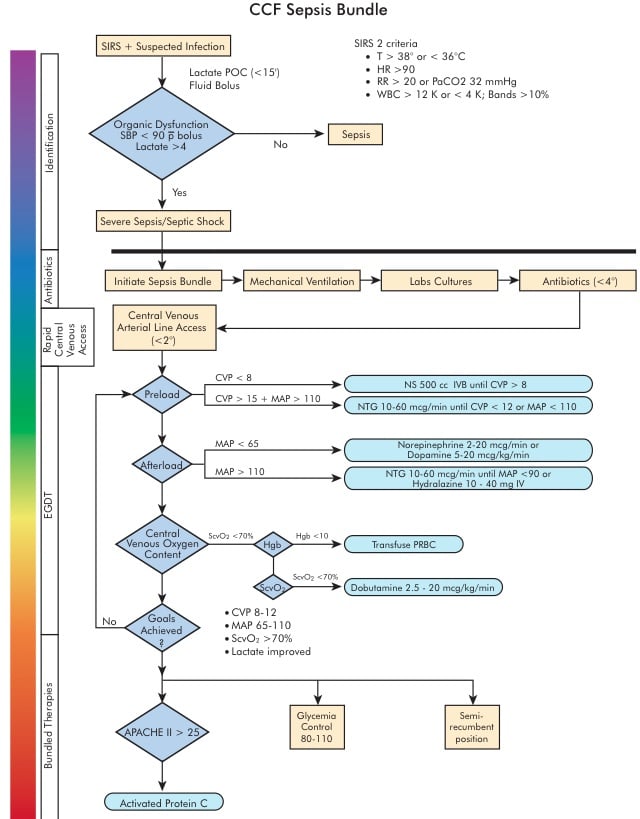
Trick of the Trade: Serial lactate measurements in sepsis?
Does your Emergency Department have computerized spectrophotometric catheters to measure continuous central venous oxygen saturation (ScvO2) in early goal directed therapy (EGDT) for severe sepsis? That’s what was used in the original Rivers’ EGDT study. I’ve never even seen one before. [+]

Trick of the Trade: Conveying risk for postexposure prophylaxis
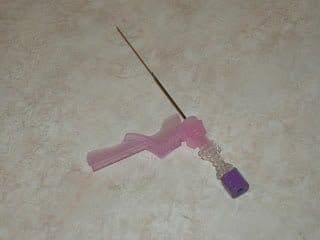
A health care worker hurried in to the ED after being poked with a needle. ‘It was an old 18G needle with dried blood’, she said. Her puncture had drawn blood. You discussed the very low risk of contacting HIV and the side effects of postexposure prophylaxis (PEP). She asked, ‘What does very low risk mean?’ Is there another way to covery risk for patients? [+]

Paucis Verbis: Management of Accidental Hypothermia
With all of the amazing, sunny weather here in California, I feel (briefly) terrible for all those braving the snowpocalyptic conditions across the United States. So, in honor of all those bundled up and shivering, I wanted to review the management of accidental hypothermia. Tip: Avoid jostling the hypothermic patient too much because of myocardial irritability. Don't send your patient into an arrhythmia. PV Card: Management of Accidental Hypothermia Go to ALiEM (PV) Cards for more resources.
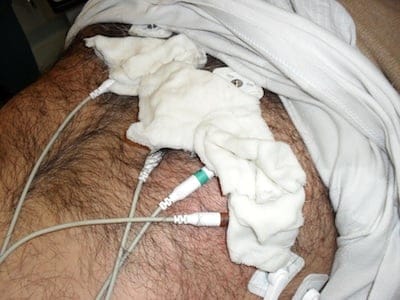
Trick of the Trade: Getting an EKG on Chewbacca
Patients with a hairy chest may require little patches of hair to be shaved when applying EKG leads. This allows the leads to stick firmly to the chest. Loose leads will result in either an artifactual signal or no signal at all on the EKG machine. How can you obtain an EKG without shaving little patches on the patient’s chest? [+]

Paucis Verbis card: The Shoulder Exam
How many times have you had to look up the shoulder exam maneuvers for patients with acute shoulder pain? I don't know why I just can't seem to remember these. This Paucis Verbis card is a quick reference card to remind you of the most common techniques. Thanks to Jenny for the idea. PV Card: Shoulder Exam Go to ALiEM (PV) Cards for more resources.
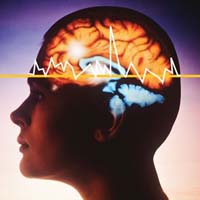
Paucis Verbis card: Generalized Convulsive Status Epilepticus
How do you manage patients who present in status epilepticus, knowing that "time is CNS function"? The longer patients remain seizing, the greater their morbidity and mortality. Did you know that one study showed that 48% of their patients who presented in generalized convulsive status epilepticus (GCSE) had subtle persistent GCSE on EEG, despite no clinical evidence of overt seizure activity? That's scary. Do you send off a serum tricyclic toxicology screen for all your patients with GCSE? Because of the prevalence of TCA overdoses locally, our Neurology consultants definitely order it. We are picking up a surprising number of [+]
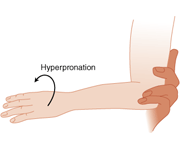
Tricks of the Trade: Nursemaid elbow reduction
We’ve all seen it before while working in the ED. A parent brings in their child because they pulled on their arm, and now the child is not using it. Parents are thoroughly convinced that the child’s arm is either broken or dislocated. We all recognize this as radial head subluxation or “nursemaid’s elbow” and immediately attempt to reduce it. The provider takes the injured arm, supinates at the wrist and flexes at the elbow. Does the child scream? What if nothing happens? Is there an alternative technique to reducing a nursemaid elbow? [+]
Paucis Verbis card: Workup for first-time seizure
How do you workup adult patients who present with a new-onset seizure and now neurologically back to normal? There unfortunately is very little recent literature about the best workup approach. In 1994, the American College of Emergency Physicians (ACEP) published a Clinical Policy based on expert consensus. The EM Clinics of North America series also just published a review on the topic. The bottom-line is that there are two types of workup approaches. For the uncomplicated cases (age less than 40 years, afebrile, no comorbidities, no neurologic deficits), the workup is fairly minimal, which includes: Glucose and electrolytes Urine pregnancy test, [+]
Trick of the Trade: Reducing post-LP headache risk
We often do lumbar puncture in the ED. Patients get warned about the potential of a post LP headache. What is the prevalence of a post-LP headache? The literature reports 15% of ED patients have a post LP headache. [+]

Director of Growth, Strategic Alliance Initiative, Center for Innovation and Digital Health
Massachusetts General Hospital;
Chief Scientific Officer, Conductscience.com
Latest posts by Shuhan He, MD (see all)
- The Discharge Severity Index: Early Research on ED Readmission Risk Assessment - August 14, 2025
- Suboxone and the Emergency Physician: Get Waivered Training - August 12, 2022
- A Tale of Two Epidemics: COVID-19 and the Opioid Crisis - April 23, 2020