


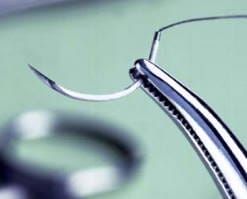
Paucis Verbis card: Suture Materials
Suturing is a common procedure performed in the ED, but we too often forget about the nuances of different suture materials. We get set in our practice patterns. This changed when our ED got the fast-absorbing gut suture for surface wounds, especially for pediatric patients. This makes a return visit for suture removal unnecessary because they quickly become absorbed over time. Increasingly, I have observed plastics surgeons using these for surface wound closure of the face and hands. Has anyone else used absorbable sutures on the skin for wound closure? With this new suture material in my armamentarium, I thought [+]
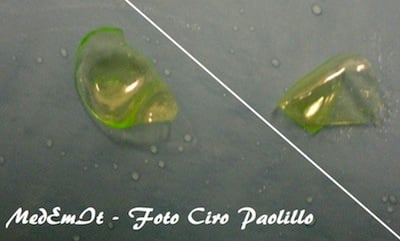
Tricks of the Trade: Finding the wandering contact lens
Contact lens wearers are familiar with the phenomenon of the wandering lens. What should you do if you can’t visualize the contact lens of a patient, who presents with a “lost contact lens” in the eye? You have the patient look in all directions and you evert the eyelid, but still no contact lens can be found. The patient swears that it’s there because of the painful foreign-body sensation. [+]

Paucis Verbis card: Subarachnoid hemorrhage high-risk characteristics
In Wednesday's post about the Colorado Compendium, Graham mentioned a new 2010 BMJ article on the high-risk signs suggestive of subarachnoid hemorrhage by the gurus in clinical prediction rules in Canada. We excessively work-up patients for a subarachnoid hemorrhage with a nonspecific headache and no neurologic deficitis. This is because it's difficult to predict who is high, medium, and low risk for such a bleed. So we throw a wider net so that we don't miss such a devastating diagnosis. This usually means a CT and LP for many patients with a headache. In this 5-year multicenter study, the investigators [+]
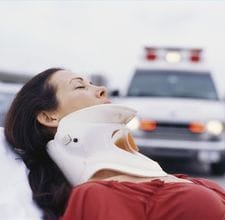
Paucis Verbis card: Cervical spine imaging rules
There is constant debate on whether to image the cervical spine of blunt trauma patients. Fortunately, there are two clinical decision tools available to help you with your evidence-based practice. The NEXUS and Canadian C-spine Rules (CCR) are both validated studies which both quote a high sensitivity (over 99%) in detecting clinically significant cervical spine fractures. Both studies primarily used plain films in evaluating their patients. Sensitivity (%) Specificity (%) NEXUS 99.6 12.6 CCR 99.4 45.1 NEXUS National Emergency X-radiography Utilization Study A patient’s neck can be clinically cleared safely without radiographic imaging if all five low-risk conditions are [+]

Trick of the Trade: Self-Reflection
After a shift, we often review the day’s case with our learners. We sometimes ask them to self-reflect. I often used Demian’s ‘Plus/Delta’ approach and ask ‘What did you like /what would you change?’ This approach works well mostly. But, when the answer is ‘I don’t think I would change anything’, it is hard to target teaching and feedback to the learner’s need. [+]
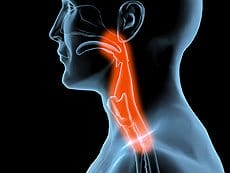
Paucis Verbis card: Dysphagia
Dyphagia is a disorder of swallowing. It actually occurs in up to 10% of adults older than 50 years old. How can you determine the most likely causes for dysphagia? The secret is to obtain a thorough history and using the algorithm below, which I find really helpful from a review article in American Family Physician. How do you read the figure? Determine first if patient has oropharyngeal vs esophageal dysphagia. Determine if mechanical (problem is solid foods only) vs neuromuscular (problem with liquids and solids)is more likely. Tip: Medications can cause dysphagia from esophageal mucosal injury or reduced lower [+]
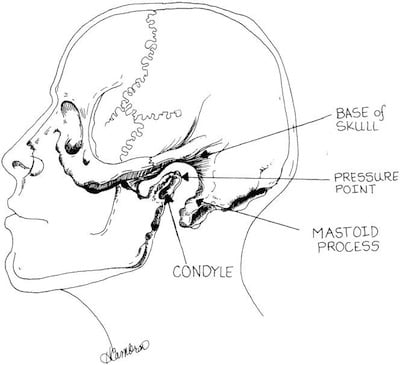
Trick of the Trade: Laryngospasm notch maneuver
What is the incidence of laryngospasm in pediatric patients receiving ketamine for procedural sedation in the ED? Answer = 0.3% A child with laryngospasm can be a scary thing to manage. There’s no way to predict whether a child is going to get it. You can try the usual maneuvers including a jaw-thrust, positive pressure ventilation to try to open the vocal cords, and suctioning. If these don’t work, you might consider giving the patient a paralytic, such as succinylcholine, and performing an endotracheal intubation for worsening hypoxia. Before that, what non-invasive maneuver can you try first? [+]
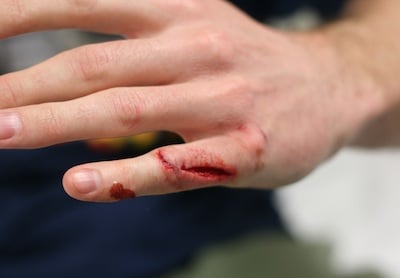
Trick of the Trade: Hemostasis of bleeding finger laceration using a glove
Lacerations of the finger can bleed quite profusely because of digital vascularity. This obscures the provider’s ability to perform a careful exam and can make suturing quite difficult. Simple direct pressure over the laceration often controls the bleeding. What if this doesn’t work? [+]

Paucis Verbis: Identifying toxidromes by vital signs
A middle-age woman presents to the Emergency Department with altered mental status after having ingested a drug. Is it an opioid? Is it an antihistamine? The key is to pay close attention to the vital signs. They are often the clue to the mystery. I found this great table from EM Clinics of North America by Dr. Timothy Erickson from 2007. I can't imagine how long it took for him to create all these mnemonics. I'll never remember these mnemonics, but they're fun to read nonetheless. PV Card: Toxidromes by Vital Signs Go to ALiEM (PV) Cards for more resources.

New 2010 ACLS guidelines from the AHA, ERC, and ILCOR
Last month the AHA, ERC, and ILCOR released the 2010 Resuscitation Guidelines. They build on the 2005 and previous guidelines and continue the trend towards more, higher quality, uninterrupted CPR. The complete summary and recommendations are published in Circulation and are available for free. Here is my summary for you! [+]

Director of Growth, Strategic Alliance Initiative, Center for Innovation and Digital Health
Massachusetts General Hospital;
Chief Scientific Officer, Conductscience.com
Latest posts by Shuhan He, MD (see all)
- The Discharge Severity Index: Early Research on ED Readmission Risk Assessment - August 14, 2025
- Suboxone and the Emergency Physician: Get Waivered Training - August 12, 2022
- A Tale of Two Epidemics: COVID-19 and the Opioid Crisis - April 23, 2020