


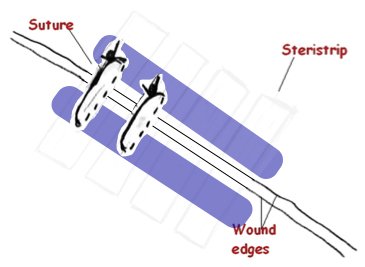
Trick of the Trade: Steristrip-suture combo for thin skin lacerations
Lacerations of elderly patients or chronic corticosteroid users can be a challenge because they often have very thin skin. Sutures can tear through the fragile skin. Tissue adhesives may not adequately close the typically irregularly-edged laceration. How do you repair these lacerations? Do you just slap a band-aid on it? [+]

Paucis Verbis: Chemical sedation for severe agitation
Haldol, Ativan, and Versed... oh my. In the Emergency Department, some patients present very acutely and aggressively agitated. This is usually the result of illicit drug use or a schizophrenic who hasn't been taking medications (or both!). Fortunately, we have an arsenal of medications to help sedate the patient. One study looked to answer the question of what single IM sedation agent is most effective, as measured by the shortest time to sedation and time to arousal. PV Card: Chemical Sedation for Agitation Adapted from [1] Go to ALiEM (PV) Cards for more resources. Reference Nobay F, Simon BC, [+]
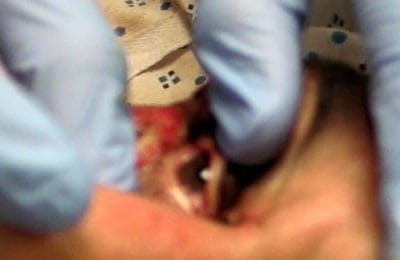
Trick of the Trade: Benzoin for opening traumatic, swollen eyelids
Patients who sustain facial trauma often have swollen eyelids. They may be so swollen that it is impossible to pull back the eyelids for an ocular exam. You use one of our “Tricks of the Trade”ideas and attempt to “roll” the upper eyelid using the Q-tip trick (above).Fresh blood on the face, however, makes the Q-tip a little slippery along the upper eyelid, preventing an adequate view of the eye itself. [+]
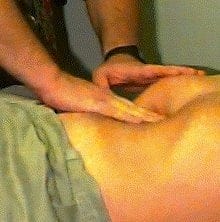
Paucis Verbis: Strength of diagnostic tests for cholecystitis
You have a 40 year-old man who presents to the ED for persistent right upper quadrant abdominal pain for 12 hours after eating a fatty meal. He has no fevers, nausea, flank pain, or dysuria. His physical exam shows no fever and only moderate tenderness in the RUQ without guarding. He has a Murphy's sign which is improved after a total of 8 mg of IV morphine. His laboratory results, which include a WBC, liver function tests, lipase, and urinalysis, are normal. Can you safely say that the patient doesn't have cholecystitis? Can you discharge him for outpatient ultrasonography to [+]

Trick of the Trade: Topical anesthetic cream for cutaneous abscess drainage in children
Abscess drainage can be painful and time consuming in the ED. Can this article help? 1 Trick of the Trade Apply a topical anesthetic cream on skin abscesses prior to incision and drainage (I and D). In this press-released article in American Journal of Emergency Medicine, the authors found that application of a topical 4% lidocaine cream (LMX 4) was associated with spontaneous cutaneous abscess drainage in children. [+]

Paucis Verbis: Right and posterior ECG leads
A standard 12-lead ECG can be very telling for patients with chest pain or shortness of breath. A right ventricular (RV) and posterior wall infarct, however, can present very subtly. You can obtain special right-sided (V1R-V6R) and posterior leads (V7-V9), if you are concerned. What are the indications for obtaining right-sided and posterior ECG leads? Go to the ALiEM Cards for more resources. Addendum 3/11/11: Right sided ECG leads (V1R-V6R) are positioned in a mirror image fashion from the standard 12-lead precordial leads. Posterior ECG leads (V7-V9) are applied by moving V4-V6 in the posterior positions.

Trick of the Trade: Heat it up!
What is it about heat that makes everything feel better? Fireplace, hot tub, heat packs, electric blankets, and hot chocolate have got to be the best inventions EVER. How can we apply this in Medicine? [+]

Trick of the Trade: Website resource on HIV medications
At our department’s first annual UCSF High Risk Hawaii Conference 2 weeks ago, Dr. Rachel Chin taught about complications from all of the HIV drugs on the market now. It’s a virtual alphabet soup: EFV, TDF, FTC, oh my. How do you keep track of them all? [+]

Hot off the press: Clinical practice guideline for ketamine in the ED
A 3 year old girl is brought into the ED with an abscess to her groin. Upon examination it is fluctuant and needs incision and drainage. Next door is a 5 year old boy, who fell off his bed and has an angulated radius fracture that needs reduction. Hhhmmmm…how to manage these patients? Local anesthesia? Hematoma block? Nothing (aka brutacaine)? What about ketamine, that seems popular these days. IV? IM? With or without atropine? So many decisions! Luckily you were surfing the internet one night and came across the 2011 clinical practice guideline on ketamine in the ED, which was [+]
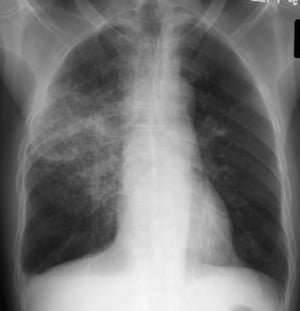
Paucis Verbis: Pneumonia risk stratification tools
Pneumonia is a common cause for ED visits. How do you decide on whether the patient can be managed as an outpatient or inpatient? To supplement your clinical judgment, many clinicians use the Pneumonia Severity Index (PSI) score. Have you heard of CURB-65, supported by the British Thoracic Society? What about SMART-COP, which is meant to help you predict if your patient will need Intensive Respiratory or Vasopressor Support (IRVS)? PV Card: Risk Stratification Scoring Tools in Pneumonia Go to the ALiEM Cards for more resources.

Director of Growth, Strategic Alliance Initiative, Center for Innovation and Digital Health
Massachusetts General Hospital;
Chief Scientific Officer, Conductscience.com
Latest posts by Shuhan He, MD (see all)
- The Discharge Severity Index: Early Research on ED Readmission Risk Assessment - August 14, 2025
- Suboxone and the Emergency Physician: Get Waivered Training - August 12, 2022
- A Tale of Two Epidemics: COVID-19 and the Opioid Crisis - April 23, 2020