


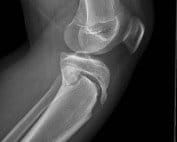
SplintER: Knee pain after the jump
A 15 year-old male presents to the emergency department with left knee pain and swelling after jumping while attempting to dunk a basketball. You obtain a knee x-ray (image 1 courtesy of Mark Hopkins, MD). What is your diagnosis? What patient population is at risk for this injury? What other injuries occur in this anatomical location? What is your emergency department management? [+]

ACMT Toxicology Visual Pearls: The Blood Sample Doesn’t Look Right
Which administered antidote causes this appearance in a blood sample? a) Hydroxocobalamin b) Intravenous Lipid Emulsion (ILE) c) Methylene blue d) N-acetylcysteine [+]

Austin Costa, MD
Carolinas Medical Center
Charlotte, NC
Latest posts by Austin Costa, MD (see all)
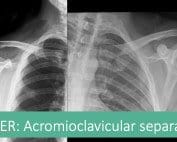
SplintER Series: Two cases of shoulder pain
Two patients present to your emergency department: Patient 1 is a 17 year-old soccer player who fell during a game onto their right side and is now complaining of mild right shoulder pain. You obtain x-rays (Figure 1). Patient 2 is a 21 year-old motorist who lost control and went over the handlebars. They heard a pop and are complaining of left shoulder pain. You obtain shoulder x-rays (Figure 2). For these cases, what are your diagnoses, expected physical examination findings, and emergency department management? [+]
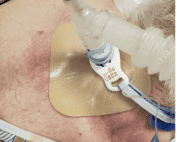
Trick of the Trade: Tracheostomy leak temporization
Patients who are tracheostomy and ventilator dependent are at increased risk for complications the longer they remain in this condition. One common complication is tracheomalacia. Progressive tracheomalacia can lead to air leaks around the tracheostomy cannula balloon. Initially, this can be managed by placing a longer tracheostomy cannula deeper into the trachea, however, these are often unavailable in the emergency department [1]. A second line strategy is to temporarily over-inflate the balloon, however, with chronic overinflation, eventually both the trachea and the neck stoma become too large, leading to an inability to maintain appropriate positive pressure (PEEP) and tidal volume [+]
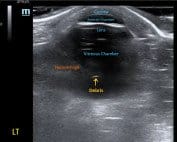
Gaining the Diagnosis of Vitreous Hemorrhage with Ultrasound
A 54 year-old male presents to the emergency department with an eye complaint. The patient works as a cook and while cleaning the grill several hours ago felt something fly into his eye. He did not immediately feel pain, but notes blurred vision and an increasing pressure-like sensation in his left eye. He describes his left-sided blurred vision as a haziness, like cobwebs over his eye. He has been able to open his eye and keep it open without difficulty. [+]

ALiEM AIR | Respiratory 2019 Module
Welcome to the AIR Respiratory Module! After carefully reviewing all relevant posts from the top 50 sites of the Social Media Index, the ALiEM AIR Team is proud to present the highest quality online content related to respiratory emergencies. 8 blog posts within the past 12 months (as of November 2019) met our standard of online excellence and were curated and approved for residency training by the AIR Series Board. We identified 2 AIR and 6 Honorable Mentions. We recommend programs give 4 hours (about 30 minutes per article) of III credit for this module. [+]

SAEM Clinical Image Series: Tick Bite
A 14 year old girl presenting from Mexicali with altered mental status. Her mother reports a rash about a week ago following a tick bite. She had been going to school until 4 days ago when she became very fatigued with associated vomiting, diarrhea, tactile fevers, and headache. She subsequently collapsed at home today and was difficult to arouse which prompted EMS activation. Her mother denies any prior complaint of neck stiffness, shortness of breath, cough, hematemesis, or hematochezia. [+]
SplintER Series: The Recurrent Shoulder Dislocation
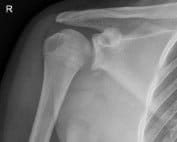
A 17 year-old football player with prior shoulder dislocation presents to the emergency department reporting shoulder pain after fall. You obtain shoulder x-rays and see the following injury (Image courtesy of Richard Hopkins, MD). What is your diagnosis? Are there any associated lesions you could expect to find? What is your emergency department management? [+]


ACMT Toxicology Visual Pearls – Look, Don’t Touch
What toxin is responsible for the most serious clinical effects experienced by patients bitten by the creature in this photo? latrotoxin Conotoxin Helothermine Tetrodotoxin Verrucotoxin [+]

Trick of the Trade: Directed Saline Irrigation for Nasal Suctioning
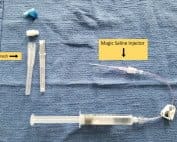
You are just starting out your mid-January evening shift, and you go to the room of an 8-month old male with nasal congestion. He is afebrile, and mildly tachycardic, but his lung exam is fairly benign and he’s breathing easily without retractions. You can clearly see he has congestion. You instruct the parents to use saline irrigation and then nasal suctioning to clear the congestion as needed, and they say, “How can we do this if our child struggles? Won’t we just end up with a wet, angry, and congested child?” [+]

Director of Growth, Strategic Alliance Initiative, Center for Innovation and Digital Health
Massachusetts General Hospital;
Chief Scientific Officer, Conductscience.com
Latest posts by Shuhan He, MD (see all)
- The Discharge Severity Index: Early Research on ED Readmission Risk Assessment - August 14, 2025
- Suboxone and the Emergency Physician: Get Waivered Training - August 12, 2022
- A Tale of Two Epidemics: COVID-19 and the Opioid Crisis - April 23, 2020