


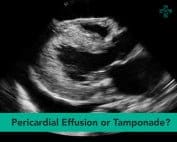
Differentiating pericardial effusion from pericardial tamponade on ultrasound
Tamponade physiology, in which a pericardial effusion impedes cardiac output, is a medical emergency and requires prompt diagnosis and intervention before cardiovascular collapse ensues. However, not every fluid collection in the pericardial sac results in tamponade physiology. A clinical diagnosis of tamponade (Beck’s triad) has poor sensitivity and will occur only in the late stages of tamponade.1 In order to know whether or not an intervention is necessary for the setting of pericardial effusion, ultrasound diagnosis of tamponade is paramount. [+]

Ultrasound for the Win! 18M with dysphagia #US4TW
Welcome to another ultrasound-based case, part of the “Ultrasound For The Win!” (#US4TW) Case Series. In this case series, we focus on a real clinical case where bedside ultrasound changed the management or aided in the diagnosis. In this case, an 18-year-old man presents with a sore throat. [+]

Kelly Goodsell, MD

PEM Pearls: 5 Tips to Demystify Amoxicillin in Pediatric Infections
Amoxicillin is a penicillin derivative antibiotic against susceptible gram positive and gram negative bacteria. It has reasonable coverage for most upper respiratory infections and is used as prophylaxis for asplenia and bacterial endocarditis. This post aims to demystify amoxicillin treatment for common pediatric infections. [+]

Rosy Hao, MD
SUNY Downstate and Kings County Medical Center
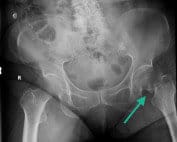
Fascia iliaca nerve block: A hip fracture best-practice
An 82-year-old woman presents with left hip pain after a mechanical fall while cleaning the kitchen floor. When EMS arrived, the left leg was foreshortened and externally rotated. The paramedics administered 10 mg of IV morphine, but she is still writhing in pain on arrival. The AP pelvic x-ray demonstrates a left femoral neck fracture (arrow). You consider performing a fascia iliaca nerve block for better pain control. [+]

SAEM Clinical Image Series: Facial Swelling in a 2 Year Old
[Click for larger view] Chief complaint: Left-sided facial swelling History of Present Illness: A 2-year-old male presents to the emergency department in January after waking up with left-sided facial swelling. Mother states her son has had cough and congestion for the past 4 days for which she has been giving Tylenol and a children’s cough medication. The patient went to bed, awoke the following morning with facial swelling, and was brought to the emergency department. He has no allergies, history of trauma to the area, or bug bites. The patient is fully vaccinated including [+]

ACMT Toxicology Visual Pearls: Mushroom Mania
After eating the mushroom pictured, a 15-year-old patient arrives to the emergency department agitated, diaphoretic, and hallucinating, and then acutely becomes more somnolent and less responsive. Which neurotransmitter systems are affected by the toxins contained in this mushroom? Acetylcholine and histamine Dopamine and norepinephrine Gamma-aminobutyric acid (GABA) and N-methyl-D-aspartate (NMDA) Glycine and serotonin [+]

Mary Grady, MD
Department of [+]
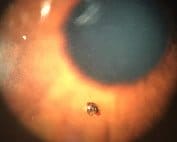
SAEM Clinical Image Series: Corneal Foreign Body
[Click for larger view] Chief complaint: Eye pain History of Present Illness: A 41-year-old man presents with pain and a foreign body sensation in the right eye since welding 4 days ago. The patient wore eye protective gear; however, he explains that he only wore sunglasses. A spark flew in from above his glasses and hit him in the right eye. The pain has been steady since. He complains of irritation exacerbated by blinking, but vision has remained unchanged. He has no other injury and no other physical complaint. [+]

SAEM Clinical Image Series: Tea & Toast | A Case of an Abdominal Rash
[Click for larger view] Chief complaint: Abdominal pain, nausea, and vomiting History of present illness: A 46 year-old female with a past history of fibromyalgia, irritable bowel disease, and chronic abdominal pain presented to the emergency department with abdominal pain, nausea, and vomiting. She reported a one-year history of similar symptoms but states that her symptoms are worse today than usual, and not improved by her home hydrocodone, medical marijuana, or heating pad use – all of which she uses daily. She has not been able to tolerate oral intake today, vomiting up her [+]
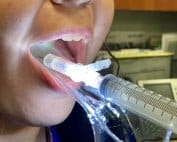
Trick: Peritonsillar abscess drainage 3.0 | All the steps with added variations
A 25-year-old medical student comes in with a muffled voice, sore throat and trismus. You look at the back of her throat and you see the uvula deviated to the right. You astutely diagnosed a peritonsillar abscess (PTA). You consider aspirating and want to check for tips on how to successfully do this.Dr. Michelle Lin and Dr. Demian Szyld have created great guides for the common and important emergency medicine procedure of draining a PTA (laryngoscope lighting and spinal needle for aspiration; ultrasound localization and spinal needle guard; avoiding awkward one-handed needle aspiration). This update reviews these tricks as well [+]

PEM Pearls: Ultrasound for Diagnosing Occult Supracondylar Fractures
Supracondylar humerus fractures are the most common type of elbow fracture in pediatric patients, most often seen in a fall on an outstretched hand (FOOSH) or a fall on a hyper-extended elbow.1,2 If there is no obvious fracture on x-rays, the patient may have an occult fracture; look for secondary radiographic signs including a posterior fat pad sign, an enlarged anterior fat pad or ‘sail sign’, or malalignment. Occult supracondylar fractures (those with initial normal radiographs that are later diagnosed in follow up) make up 2-18% of all the fractures we see in kids.3 When x-ray findings are nonspecific but the [+]

Director of Growth, Strategic Alliance Initiative, Center for Innovation and Digital Health
Massachusetts General Hospital;
Chief Scientific Officer, Conductscience.com
Latest posts by Shuhan He, MD (see all)
- The Discharge Severity Index: Early Research on ED Readmission Risk Assessment - August 14, 2025
- Suboxone and the Emergency Physician: Get Waivered Training - August 12, 2022
- A Tale of Two Epidemics: COVID-19 and the Opioid Crisis - April 23, 2020