



Motivation and Self Determination Theory
Motivation is one of those important elements in our personalities that helps us have a drive for improvement. Motivation can come in two flavors internal and external. Self determination theory (SDT) is a psychological term which explains people’s internal motivation and determination to their behavior. Edward L. Deci and Richard M. Ryan explored SDT further and determined there were three basic needs in every human, which are universal, not learned, and seen across gender and culture. [+]
High Sensitivity Troponin Testing
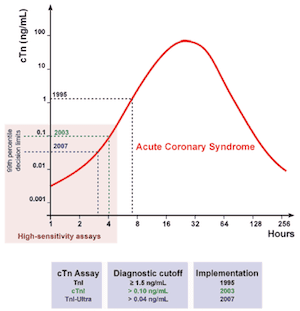
Troponin testing is an important component of the diagnostic workup and management of acute coronary syndromes (ACS). The increasing sensitivity of troponin assays has lowered the number of potentially missed ACS diagnoses, but this has also created a diagnostic challenge due to a decrease in the specificity of the test. From 1995 to 2007, the limit of troponin detection fell from 0.5 ng/mL to 0.006 ng/mL (see below graph). Robert Jesse summed up this frustration with the following quote: When troponin was a lousy assay it was a great test, but now that it’s becoming a great assay, it’s getting [+]

Are Acetaminophen Levels Necessary in All Overdose Patients?
Intentional overdose patients are notorious for giving inaccurate histories. “I took 14 tablets of this and 8 capsules of that. No, wait. It was 3 tablets of this and a handful of capsules of that… This happened about 2 hours ago. Actually, I think it was last night.” Round and round the merry-go-round we go. How should we risk-assess whether acetaminophen is involved? If the patient provides no history of acetaminophen ingestion, do we need to order a level? [+]
Introducing Open, Post-Publication, Expert Peer Review on ALiEM
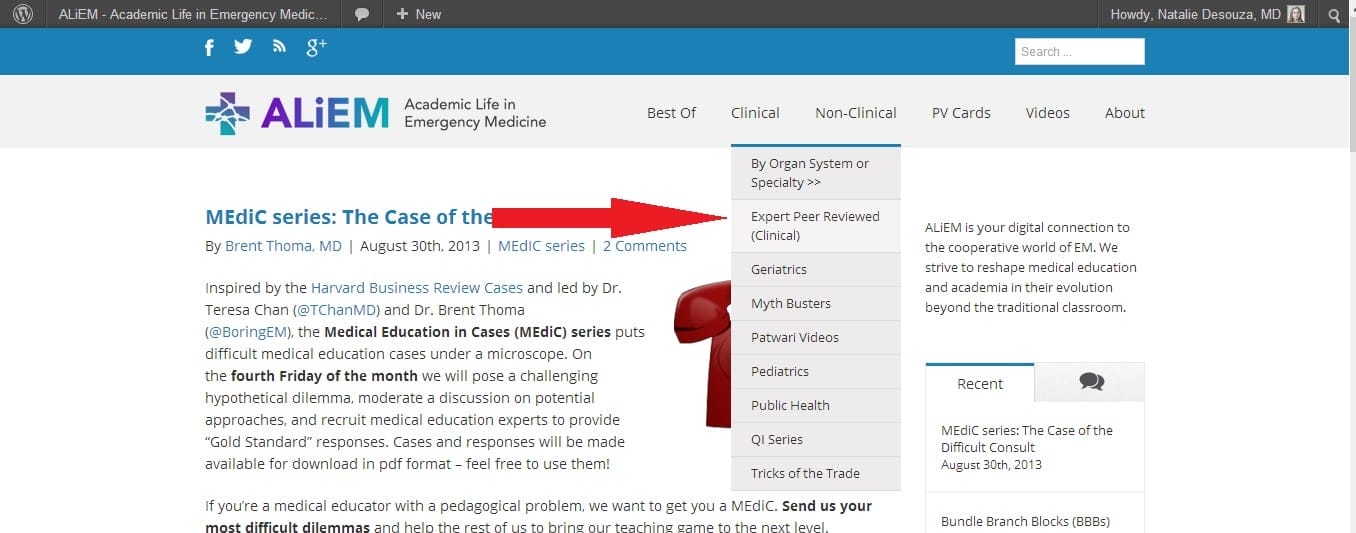
Today, we are busting open the concept of peer review for publications on blogs! The peer review process has been criticized for its flaws, but is universally accepted as a necessary part of the scientific process. Peer reviewing allows experts in a field to determine the validity of a study or an article so that those of us who are less expert can reap the benefits of their knowledge. Until recently this process was almost universally pre-publication and anonymous. Authors would go through months of review and revision based on feedback of experts whose name they didn’t even know. In the [+]
Welcome ALiEM Resident Editor Dr. Natalie Desouza
There are many things that print journals do well. One of the best ideas that I have seen from the Annals of Emergency Medicine is the unique idea of having a Resident Editor on the executive team. This provides the resident exposure to the behind-the-scenes operational processes of running a journal under a mentored environment. Similarly, ALiEM has experienced such rapid growth in the past year with the addition of amazing regular bloggers that we are ready to welcome our first Resident Editor Dr. Natalie Desouza (UCSF-SFGH EM senior resident). [+]
Alcohol Problems Among Older Adults in the ED
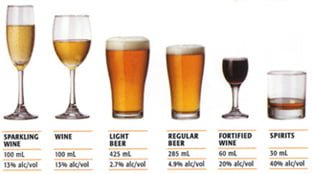
The complications of alcohol use can be subtle in older adults, and the effects of alcohol are often incorrectly attributed to aging. Because of its under-recognition, the barriers to screening, and the many subtle ways in which it can present, some have suggested that alcohol misuse has replaced syphilis as the “great masquerader”. If you don’t think alcohol misuse is a problem among older adults in your ED, it may be because it has been hidden in plain sight. [+]

Share your tips: Managing digital information overload
In this digital age, it is somewhat assumed that you know how to manage all the digital information coming at you in the forms of email, Facebook, Twitter, blogs, podcasts, RSS feeds. Even if you only partake in email as your primary communication platform, information still can be quite overwhelming as a trainee or practicing medical provider. At a the annual Bay Area EM residency conference last week, Dr. Charlotte Wills (Highland), Dr. Rebecca Smith-Coggins (Stanford) and I were invited by Dr. Esther Chen (UCSF-SFGH) to share some our personal insights and advice on a panel. We quickly realized that [+]

Simulation Trick of the Trade: Blindfold the Leader
Simulations are routine now in medical training. But sometimes routine can start to get boring! All learners now know, especially for high fidelity simulations, to prepare for the unexpected. The stable patient will inevitably crash, maybe when your back is turned; the confederate in the room may or may not be a friend or a foe, you may never know! But these twists have become so integral to the simulation case that most learners know how to deal with it, or at the least know to anticipate it. But here is an idea for adding a new challenge to a stale simulation case. Blindfold the leader! [+]

Open Educational Resources
The Internet has not only facilitated connectivity between people, but it has also helped us to connect with educational material quite different from that of a physical textbook. We are consuming information at a much more rapid rate, and we are also becoming producers of content online. With the use of hyperlinks we are also connecting one content material with another, allowing for a more dynamic-instantaneous flow of knowledge as opposed to the static print in a physical textbook. People have started seeing the potential that this brings to education and are placing educational content online. These educational materials include [+]

MEdIC series: The Case of the Difficult Consult
Inspired by the Harvard Business Review Cases and led by Dr. Teresa Chan (@TChanMD) and Dr. Brent Thoma (@BoringEM), the Medical Education In Cases (MEdIC) series puts difficult medical education cases under a microscope. On the fourth Friday of the month we will pose a challenging hypothetical dilemma, moderate a discussion on potential approaches, and recruit medical education experts to provide “Gold Standard” responses. Cases and responses will be made available for download in pdf format – feel free to use them! If you’re a medical educator with a pedagogical problem, we want to get you a MEdiC. Send us your most difficult dilemmas and help the rest of us to [+]