Faculty hero: Dr. Jim Adams (part 1)
There are many leaders in Emergency Medicine but there are few who are true visionaries. Dr. Jim Adams (Chair at Northwestern’s Department of EM) is one such visionary. He’s given numerous lectures, providing sage advice to faculty, residents, and students. I’ve always thought it a shame these aren’t more available to people. So I contacted Jim to learn more about him, his career path, and advice for young emergency physicians. [+]
Article Review: Performing a database search
At the end of each Academic Medicine journal issue, there is a great “last page” one-page teaching point in medical education research. There’s no earth-shattering news, but they are great reviews of key elements in education research. The most recent issue reviews the process of performing an effective database search in medical education research. It was authored by my friend Lauren, who is a medical education librarian at Stanford and a co-author with me on an annual series “Critical Appraisal in Emergency Medicine Education Research”. [+]

Paucis Verbis: Fibrinolytics for Acute Pulmonary Embolism
When would you give fibrinolytics for a Pulmonary Embolism? This Paucis Verbis card summarizes recommendations found in Circulation's recently published Scientific Statement from the American Heart Association. Although it is rare to give fibrinolytics for a pulmonary embolism (PE) in the Emergency Department, it is important to remember when lytics are indicated. PV Card: Fibrinolysis for Acute Pulmonary Embolism Adapted from [1] Go to ALiEM (PV) Cards for more resources. Reference Jaff M, McMurtry M, Archer S, et al. Management of massive and submassive pulmonary embolism, iliofemoral deep vein thrombosis, and chronic thromboembolic pulmonary hypertension: a scientific statement from the American Heart [+]

New guest blogger: Dr. Hans Rosenberg
Let's make it official. Dr. Hans Rosenberg has been contributing great content for this site. We're honored to have him officially join our blogging team! Dr. Rosenberg did his residency at the University of Ottawa, graduating in 2009. He now works at the Ottawa Hospital Emergency Department as a Consultant Staff Physician and is an Assistant Professor at the University of Ottawa. His interests in medical education are specifically related to our interaction with technology and how we use it to learn, educate and improve our practice of Emergency Medicine.
Inspirational graduation speech by Conan
“Your perceived failure can become a catalyst for profound reinvention.” “No specific job or career goal defines me, and it should not define you.” — Conan O’Brien I found this inspirational 2011 graduation speech by Conan O’Brien at Dartmouth College. It is a great mix of silly, witty, inspirational, and profound. Check it out. For those in Medicine and medical training, your dreams may change over time… and that’s ok. [+]
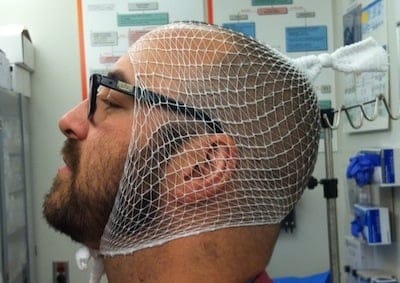
Trick of the Trade: Making a beanie hat
Scalp lacerations are a common condition in the Emergency Department. Some require no bandage over once the injury is repaired. Because the scalp is so vascular, others require a pressure dressing over the site to minimize hematoma formation. How do you bandage these patients? It is difficult to secure any wrap or square gauze over the site, because the head is round and the hair is slippery. [+]

SAEM 2012 Consensus Conference: Education Research in EM
It has just been announced that the upcoming 2012 SAEM annual meeting will feature a full-day Consensus Conference on Education Research in Emergency Medicine. In the past, Consensus Conferences have focused on such areas as “Interventions to Assure Quality in the Crowded Emergency Department” and “The Science of Simulation in Healthcare: Defining and Developing Clinical Expertise”. There’s introductory information on the SAEM Facebook page. The format is a bit cluttered, so I am reposting here below: [+]
Article review: Message for new generation of educators
An interesting article was published in Medical Education which you don’t see too often in journals. It’s a first-person reflective account of Dr. Ronald Harden’s long and internationally well-regarded career in medical education. No p-value. No sample size calculation. His experiences and lessons learned provide great insight. Here’s his advice to current and future educators. [+]
Paucis Verbis: Diagnostic testing tips for acute abdominal pain
In the most recent EM Clinics of North America publication, Dr. Panebianco et al. discussed the evidence behind diagnostic tests for acute abdominal pain. There were some really great teaching points in this broad-reaching topic. My favorite pearl: A 3-way acute abdominal series is too insensitive to rule-out any major acute causes of abdominal pain with confidence. So stop ordering them routinely. If you are worried about a perforated viscus, order an upright chest x-ray instead -- more accurate and less radiation. Adapted from [1] Go to ALiEM (PV) Cards for more resources. Reference Panebianco N, Jahnes K, Mills [+]

Advice for the new EM interns
One of my favorite blogs, Better in Emergency Medicine, by Dr. Rob Cooney reviewed the 1991 article entitled “The Ten Commandments in Emergency Medicine”. These commandments are timeless and still hold true today. Rob gives a helpful review of each commandment’s relevance in today’s ED. [+]