


Tricks of the Trade: Underwater ultrasonography
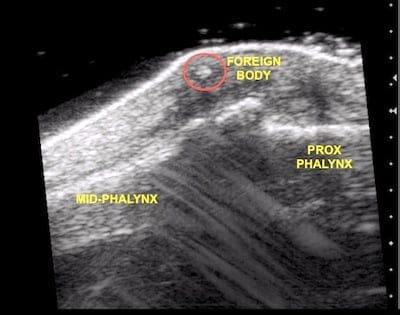
I've heard of underwater basketweaving, but underwater ultrasonography? Bedside ultrasonography is a great tool to help find small foreign bodies. Commonly foreign bodies get lodged superficially in the patient's extremities. Because superficial structures (<1 cm deep) are difficult to visualize on ultrasound, you should apply a really generous, thick layer of ultrasound gel to create some distance. Alternatively, you can add a step-off pad, such as a bag of saline or fluid-filled glove, to place between the patient's skin and transducer. What's a quicker and easier way to create some distance yet preserve image quality? Trick of the Trade Submerse [+]

TED-Ed Brain Trust: Catalyzing an education revolution
If you have not heard of TED videos, I highly encourage you to view them. They are short, inspirational, and professional talks by leaders, scientists, and artists, who focus on bringing together the 3 worlds of Technology, Entertainment, and Design. Because many of these videos focus primarily on education, TED has just built a new online community of educators called the “TED-Ed Brain Trust”. The mission is to bring together “the expertise of visionary educators, students, organizations, filmmakers and other creative professionals to guide, galvanize and ultimately lead this exciting new initiative.” [+]
Article Review: Redesigning a Powerpoint lecture using multimedia design principles
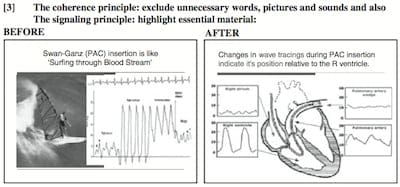
Let’s rethink how we design our Powerpoint slides. Let’s create design principles using Mayer’s cognitive theory of multimedia learning. Cognitive Theory of Multimedia Learning In a nutshell, people learn through two channels — words and images. This dual-channel theory suggests that people process auditory and visual stimuli separately. Each channel requires time to process information before merge into a cohesive cognitive concept. [+]
Paucis Verbis: NSAIDS and upper GI bleeds
Do no harm. We so often recommend and give NSAIDs to patients for various painful conditions. We also commonly administer ketorolac (toradol) in the ED, because it works so amazingly well for renal colic. When giving various NSAIDs, what is the relative risk (RR) for an upper GI bleed or perforation in the first year? Ketorolac has the highest upper GI complication RR (14.54) for all of the studied NSAIDs. Compare this with the overall risk of traditional COX-1 NSAIDS (RR=4.5) and COX-2 inhibitors (RR=1.88). So before giving ketorolac, first check that patients don't have a history of a GI [+]

Doing well as a new EM attending physician
You are super-excited to get your first real job as an emergency physician after residency. Then this immediately turns into a nauseating, super-terrified feeling, right? After posting two entries to help medical students do well on their EM clerkship rotation, a commenter suggested that I provide a list of tips for doing well as a new EM attending physician. Although there is slightly variation for community versus academic faculty, many of the basic tenets hold true: [+]
Trick of the Trade: Anesthetizing the nasal tract
One of the most uncomfortable procedures that we do on patients is a nasogastric (NG) tube. The maximal pain comes when the NG tube has to make a right angle turn in the posterior nasopharynx. The same goes for the nasopharyngeal (NP) fiberoptic scope. There are many approaches to topical anesthesia, including using benzocaine sprays, gargling with viscous lidocaine, squirting viscous lidocaine in the nares +/- afrin spray, and nebulizing lidocaine. None, however, really apply an anesthetic directly over the most sensitive area AND test for its effectiveness. [+]
Emergency Medicine factoids on Twitter
The medical profession is slowly incorporating Twitter. If you have a Twitter account, here are some great Twitter accounts to follow: [+]

Director of Growth, Strategic Alliance Initiative, Center for Innovation and Digital Health
Massachusetts General [+]
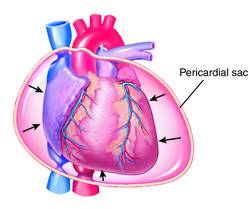
Paucis Verbis: Cardiac tamponade or just an effusion?
What is a cardiac tamponade? It is a clinical state where pericardial fluid causes hemodynamic compromise. With bedside ultrasonography in most Emergency Departments now, it's relatively easy to detect a pericardial effusion. But what we more want to know in the immediate setting is: Is this cardiac tamponade? You can look for RA systolic or RV diastolic collapse. What if it's equivocal? How good is the clinical exam and EKG in ruling out a tamponade? Answer Poor to average, at best. The Beck's triad of hypotension, distended neck veins, and muffled heart sounds are important to remember ... only on [+]
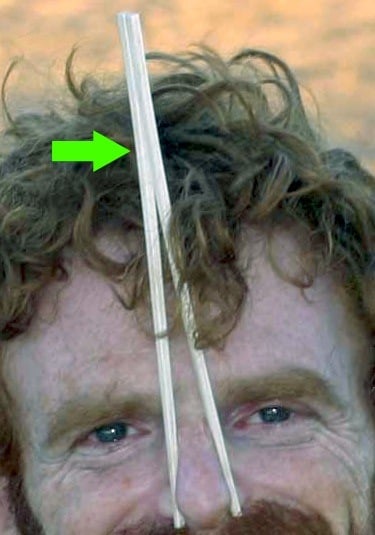
Trick of the Trade: Epistaxis control with tongue blades
For epistaxis, the classic teaching is to pinch the nose to control the bleeding. A persistent nosebleed often is the result of one’s natural inclination to constantly check if there is still bleeding every few seconds. Applying pressure on-and-off makes it difficult for the bleeding to stop. [+]
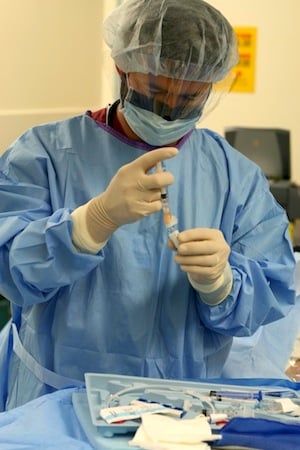
A faculty’s perspective: Doing well on your EM clerkship
To follow-up with Dr. Connolly’s perspective about the Top 10 tips for medical students to rock the EM clerkship rotation, I thought I would post some additional tips. Here are some more pearls: 11. Take ownership of your patients. This means that you should take it upon yourself to make sure that your patient’s care is stellar, addresses key clinical and social issues, and is timely. Constantly check for your patient’s results. Don’t be the last to hear of your patient’s lab or imaging results. Figure out why there are unexpected delays. Address any psychosocial issues which may hamper your [+]