SAEM Clinical Images Series: Dangerous Eye Drainage
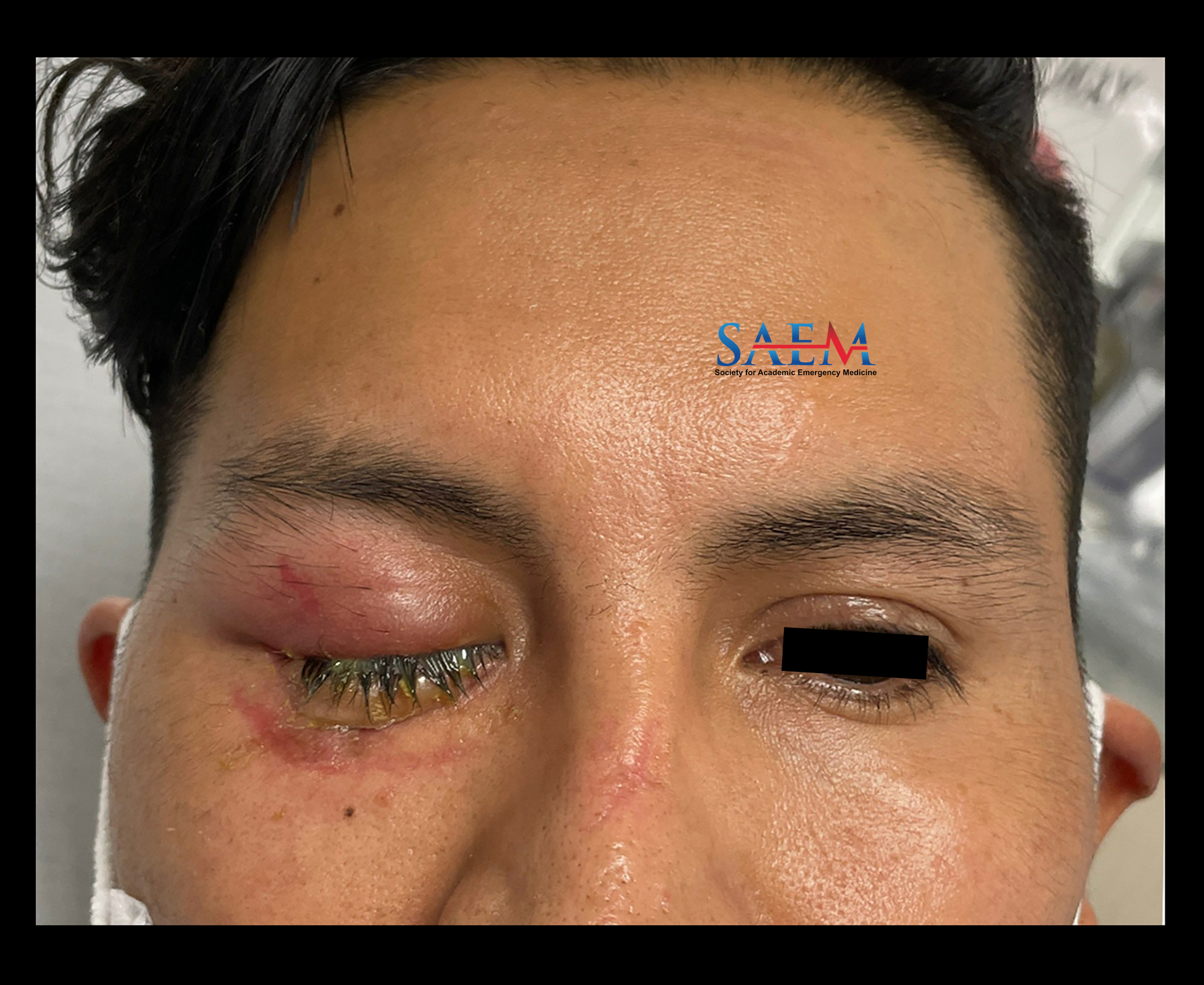
A 32-year-old man with a history of traumatic globe rupture from a stab wound two months ago, status post repair, presented to the emergency department for worsening right eye pain and green malodorous drainage for the past three days. These symptoms started when he got a fleck of sawdust in the right eye about four days prior to presentation, which he was able to brush out with his finger. He described the pain as severe, throbbing, constant, and non-radiating. He had been unable to open the right eyelid for three days, both due to pain and from the thick sticky discharge that adhered his eyelids together. He reported that his vision had been normal before these symptoms started. On review of systems, he reported nausea that started on the day of presentation but otherwise denied any vision loss or pain in the other eye.


General: Nontoxic appearing but seemed quite uncomfortable.
Eye: On inspection, he had substantial right upper and lower eyelid swelling and erythema, with a green discharge dripping from the palpebral fissure. There was a well-healed scar on the bottom eyelid. The lateral canthus appeared inferiorly displaced. The patient was unable to open his right eye actively, and was unable to tolerate passive opening due to severe discomfort, despite pain medication.
White blood cell (WBC) count: 9.1 x 10^3 /uL with 80.4% neutrophils
Complete metabolic panel (CMP): Within normal limits
Procalcitonin:<0.05 ng/mL
Lactate: 1.4 mmol/L
Cultures from the eye revealed penicillin-sensitive Streptococcus pneumoniae.
Pain with extraocular movements should be present in orbital cellulitis due to inflammation of the structures deep within the orbit. Although not sensitive, proptosis, leukocytosis & fever, chemosis, or any visual impairment should raise concern for orbital cellulitis.
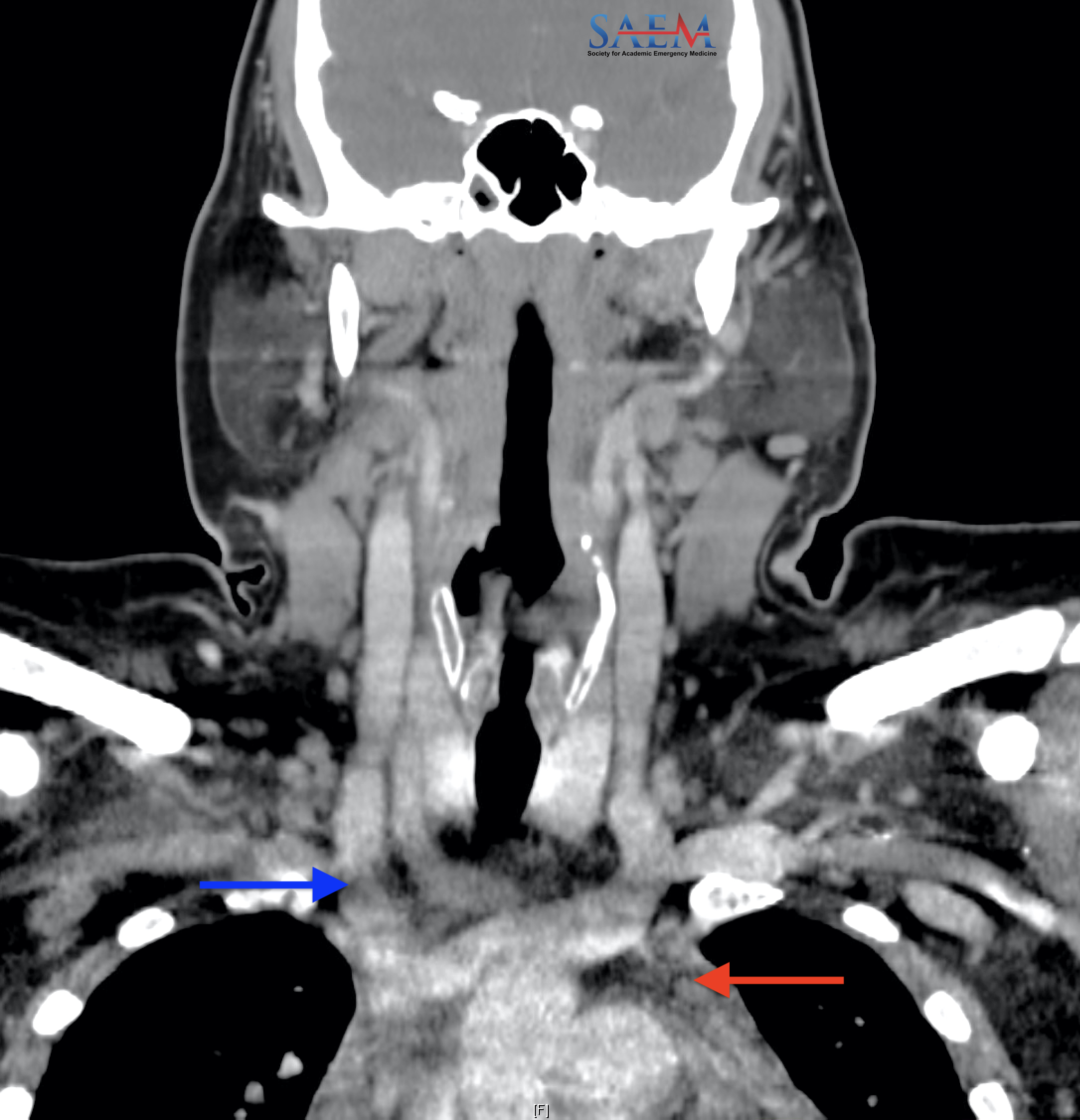
In this patient, displacement of the lateral canthus likely represents a mass effect from his orbital abscess. This abscess is seen lateral to the globe on imaging. On ultrasound, it appears as a heterogeneous isoechoic collection that abuts the right globe. A hyperechoic structure between the orbit and this collection with shadowing raises the possibility of a foreign body. Debris is also visible throughout the right globe and within the anterior chamber. On CT scan, the abscess is described as a rim-enhancing fluid collection that adheres to the lateral rectus muscle. The hyperdense foreign body is again seen on CT, as well as a small focus of air within the anterior chamber.
Take-Home Points
- Orbital abscess is an uncommon but vision-threatening ocular emergency, which can come from traumatic injury to the globe (as with this case), sinus/nasal infections, or as a complication of dental procedures.
- The most common organisms responsible for orbital abscesses are Streptococci species (including Strep. pneumoniae and Strep. pyogenes), Staphylococcus aureus (including methicillin-resistant Staph. Aureus), and Pseudomonas aeruginosa.
- Surgical management is necessary in almost all cases of orbital abscess, with just under 50% of all patients achieving complete visual recovery.
- Krohel GB, Krauss HR, Winnick J. Orbital abscess. Presentation, diagnosis, therapy, and sequelae. Ophthalmology. 1982 May;89(5):492-8. doi: 10.1016/s0161-6420(82)34763-6. PMID: 7099569.
- Zawadzki T, Komisarek O, Pawłowski J, Wojtera B, Bilska-Stokłosa J, Osmola K. Orbital Abscess-Two Case Reports with Review. Indian J Otolaryngol Head Neck Surg. 2022;74(Suppl 2):1334-1343. doi:10.1007/s12070-021-02486-z