



ALiEM AIR Series | Ortho Upper Extremity 2022 Module
Welcome to the AIR Orthopedic Upper Extremity Module! After carefully reviewing all relevant posts from the top 50 sites of the Social Media Index, the ALiEM AIR Team is proud to present the highest quality online content related to related to Orthopedic Upper Extremity emergencies in the Emergency Department. 3 blog posts met our standard of online excellence and were curated and approved for residency training by the AIR Series Board. We identified 1 AIR and 2 Honorable Mentions. We recommend programs give 2 hours (about 40 minutes per article) of III credit for this module. AIR Stamp of Approval and [+]

SplintER Series: En Pointe
A 32-year-old female presents to the emergency department with right foot pain after rolling her ankle during dance class. On exam, there is mild swelling and tenderness over the 5th metatarsal. The above x-ray was obtained (Figure 1: Case courtesy of Dr. Henry Knipe, Radiopaedia.org, rID: 28104). [+]

Ko, MD, CAQ-SM
Department of Emergency Medicine
New [+]

ALiEM AIR Series | Cutaneous 2022 Module
Welcome to the AIR Cutaneous Module! After carefully reviewing all relevant posts from the top 50 sites of the Social Media Index, the ALiEM AIR Team is proud to present the highest quality online content related to related to cutaneous emergencies in the Emergency Department. 6 blog posts met our standard of online excellence and were curated and approved for residency training by the AIR Series Board. We identified 0 AIR and 6 Honorable Mentions. We recommend programs give 3 hours (about 30 minutes per article) of III credit for this module. AIR Stamp of Approval and Honorable Mentions In an [+]
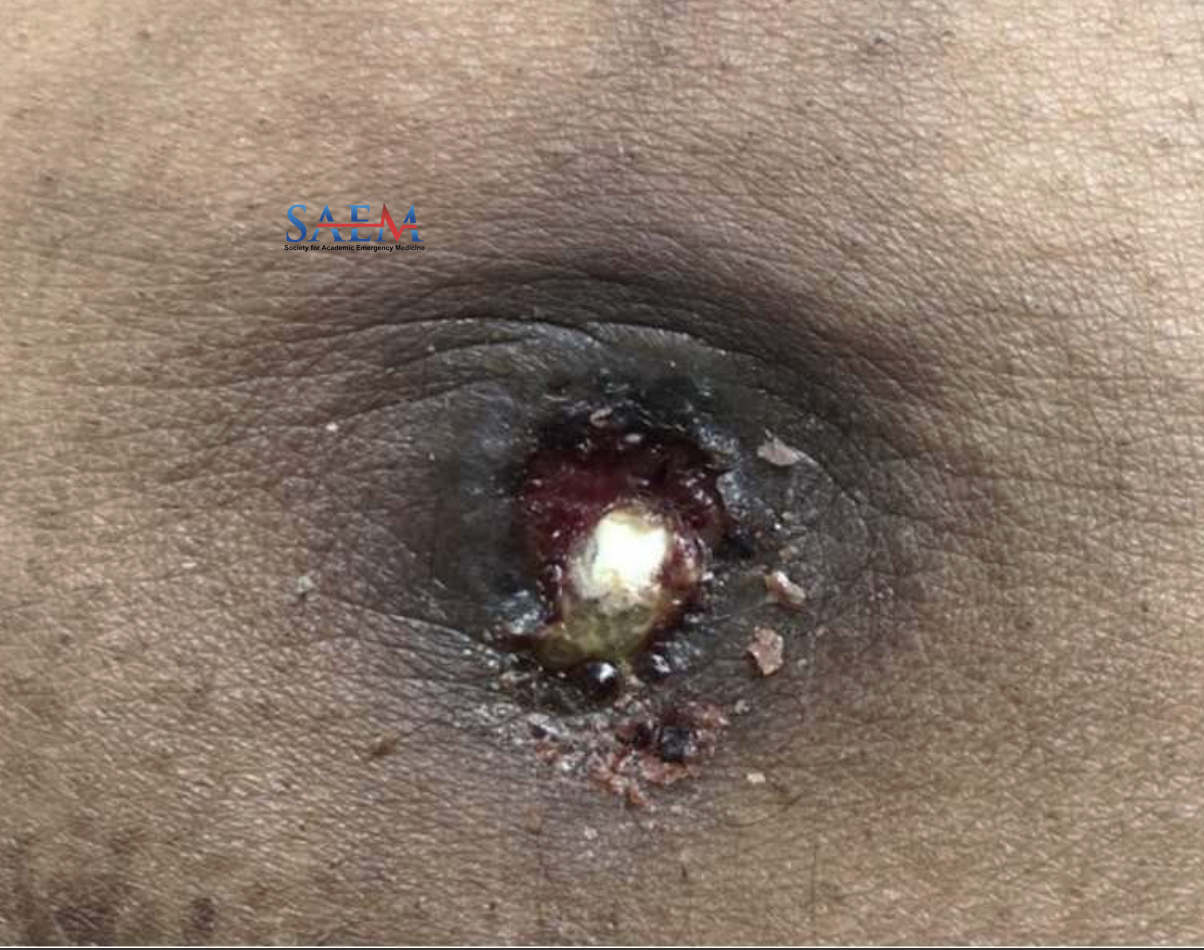
SAEM Clinical Images Series: An Ominous Umbilical Lesion
A 54-year-old male with a past medical history of atrial flutter and alcohol use disorder presents with an umbilical wound that has been bothering him for approximately six months. There is no history of trauma, prior infection, or umbilical surgery. There is intermittent mild pain and irritation that occurs randomly. No drainage or bleeding. He admits to picking at the wound regularly. He denies fever, chills, nausea, generalized abdominal pain, diarrhea, constipation, dysuria, and hematuria. The patient drinks four or more alcoholic beverages daily and has a long-standing history of tobacco use. [+]

SAEM Clinical Images Series: Dermatology Deserving a Deeper Dive
A 22-year-old female without significant past medical history presented to the Emergency Department (ED) for a progressive rash for the past six months. She had initially complained of dry and peeling skin on bilateral hands and feet and had multiple ED and dermatology encounters where topical steroids, acyclovir, and methotrexate were prescribed with no improvement. The rash continued to progress with worsening pain and inability to flex fingers secondary to lesions and scabbing at the joints. The patient also developed painful sores in her mouth primarily involving the tongue. More concerningly, she had lost 60 pounds since the onset [+]

SplintER Series: Don’t forget about the (tibial) spine!
A 13-year-old patient presents to the Emergency Department after sustaining a twisting knee injury while playing soccer. There was a pop, and the patient was subsequently unable to bear weight due to pain and knee instability. The swelling and pain increased in the hours after the injury occurred. On examination, there is a large knee effusion and a positive Lachman test. You obtain imaging (Figure 1). What is your suspected diagnosis? What is your initial workup in the ED? What imaging confirms the diagnosis? What is your management and disposition? Figure 1: AP [+]

SAEM Clinical Images Series: Facial Swelling
A 5-year-old male with a history of recent frontal sinusitis associated with preseptal cellulitis requiring surgery presented with facial swelling. Swelling developed in the 24 hours prior to presentation without facial pain, nausea, or emesis. Denied facial trauma as well as any neurologic deficits, loss of consciousness, headaches, or fever/chills. At the time of his prior surgery, he presented with swelling localized to the left eye along with worsening [+]

SplintER Series: Hip, Hip, Hooray!
A 67-year-old male with a history of bilateral total hip arthroplasties (THA) several years ago presents with left hip pain after a fall. He was walking downstairs and slipped, twisting his leg internally and with adduction and flexion of the hip to catch himself. He denies falling but felt an immediate pop in his left hip and could no longer bear weight. AP and lateral radiographs of the pelvis and left hip were obtained and are shown above (Image 1. Case courtesy of Dr Andrew Taylor, Radiopaedia.org, rID: 67457). [+]

Free Comprehensive Curriculum: Climate Change and Emergency Medicine
During the COVID-19 pandemic, a few of us interested in climate change science met through the Society for Academic Emergency Medicine (SAEM), and our group slowly expanded with the virtual world. We discussed the ever-growing number of climate publications and scholarship opportunities available. Some of us did research, education, or policy work, and all of us practiced clinically. Negative climate-related impacts that we see in the Emergency Department We discussed how climate-related impacts negatively affected our patients, and brainstormed how we could tackle the problem now. For us in Rhode Island, Pennsylvania, Wisconsin, Colorado, and California, the climate crisis [+]

SAEM Clinical Images Series: Finger Pain
A 57-year-old male presents after accidentally firing his son’s expired epinephrine autoinjector containing 0.3 mg of epinephrine into his left thumb two hours prior to arrival. He endorses mild pain and numbness at the tip of his thumb. The patient had spoken to poison control who had instructed him to present to the Emergency Department if his symptoms did not improve after two hours. He denied any palpitations or other systemic symptoms. Vitals: HR 81; BP 128/81; RR 18; SpO2 99% Extremities: Pallor noted at the distal tip of his left [+]

Director of Growth, Strategic Alliance Initiative, Center for Innovation and Digital Health
Massachusetts General Hospital;
Chief Scientific Officer, Conductscience.com
Latest posts by Shuhan He, MD (see all)
- The Discharge Severity Index: Early Research on ED Readmission Risk Assessment - August 14, 2025
- Suboxone and the Emergency Physician: Get Waivered Training - August 12, 2022
- A Tale of Two Epidemics: COVID-19 and the Opioid Crisis - April 23, 2020