


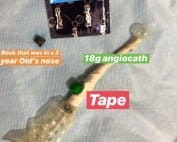
Trick of the Trade: An Improvised Foreign Body Removal Device
Foreign bodies in the ear or the nose can be extremely challenging to remove, especially considering that a majority of them occur in children less than 7 years old who are likely to be uncooperative with exam [1]. In a previous post, we emphasized the need to pick the best tool for the job in order to minimize complications. What happens when you find yourself in an austere environment and the usual tools are not available? [+]
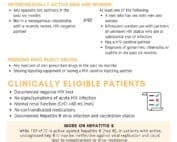
Guideline Review: Pre-exposure prophylaxis (PrEP) for HIV prevention
While HIV medications receive much attention for the treatment of HIV infection, less attention has focused on the prophylaxis indications. In 2017, the Center for Disease Control and Prevention (CDC) updated their guidelines on the indications for the HIV medications tenofovir disoproxil fumarate (TDF) and emtricitabine (2′,3′-dideoxy-5-fluoro-3′-thiacytidine, FTC) for pre-exposure prophylaxis (PrEP). The trade name for the combination medication is Truvada. These daily medications are taken by people at risk for HIV to prevent HIV. This Guideline Review succinctly summarizes the 77-page CDC document into the key pearls for emergency physicians. [+]
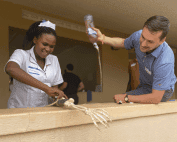
IDEA series: The Bleeding Arm Tourniquet Simulation
Education in emergency response to trauma is a global health priority [1]. Mortality rates are nearly twice as high in patients with trauma in low-income as compared to high-income countries [2]. With uncontrolled bleeding as the number one cause of death from trauma, tourniquet application has been the focus of training programs, like the “Stop the Bleed” campaign in the United States [3]. Although understanding how to apply a tourniquet is a life-saving intervention, use of a windlass tourniquet may not be intuitive [4]. The windlass tourniquet in its simplest form is the “stick-and-rope.” Winding the stick in the tourniquet [+]

A Tale of Two Epidemics: COVID-19 and the Opioid Crisis
The United States is currently dealing with 2 deadly, concurrent epidemics: COVID-19 and the opioid crisis. Both need viable solutions. The better we are equipped to address one, the more effective we can be at treating the other. Counterintuitively, now is actually the best time to get waivered. It’s imperative that we do so for 3 reasons: [+]
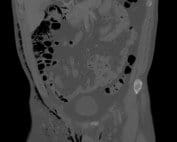
Diagnose on Sight: Scrotal Swelling
Case: A 58-year-old male with no past medical history presents to the emergency department for evaluation of right lower quadrant abdominal pain associated with right scrotal swelling. The patient reports that he had a colonoscopy the day before to remove a 20 mm polyp, which had been seen on an outpatient CT scan. He states that he noticed that his right scrotum appeared slightly swollen immediately away after the procedure, but since then the swelling had increased and he developed mild right lower quadrant abdominal pain. Physical examination reveals mild tenderness to the right lower quadrant and swelling of the [+]

EM Bound: Newsletter for medical students interested in EM
Are you a medical student, pursuing a career in Emergency Medicine (EM)? You are navigating your third and fourth years of medical school during an unprecedented time of the COVID-19 era. What if you can not get a visiting EM clerkship rotation? Are you automatically out of luck when it comes to residency applications? How do you keep apprised of timely, relevant information for residency application season? In an effort to support you and get ultra-prepared for the near future and EM internship, we are launching a monthly free email newsletter. Led by editor Dr. Sree Natesan (Assistant EM Residency [+]
LVAD Part V: The Coding LVAD Patient
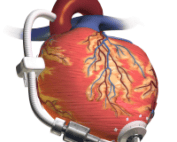
Left ventricular assist devices (LVADs) have moved from being a bridge to a heart transplant to destination therapy for patients with severe heart failure. Although their use in the general public has increased, they still provide a challenge to the emergency medicine (EM) physician. This series aims to cover the basics of how the EM physician approaches the care of these patients. [+]

Gage Stuntz

CRincubator Live: A Chief Resident Professional Development Learning Lab
"In every crisis, there is an opportunity." This famous quote by Albert Einstein illustrates the opportunity to reinvent our Chief Resident Incubator ("CRincubator") year-long experience. We had planned to retire the CRincubator as of a month ago. However, given the relative void in Chief Resident professional development opportunities this year because of physical distancing rules, we wanted to share our lessons learned and resources developed over the past 5 years. We thus announce a half-day, online, professional development learning lab opportunity to all EM Chief Residents. Come join us on May 6, 2020. Read more about the unique curriculum and [+]

How I Stay Healthy in EM: Sarah Mott
Times are hard, work is stressful. With 24/7 news and constant global pandemic updates, our once prized “work stays at work and home stays at home” mentality can be hard to maintain. With that, it seemed like an opportune time to revamp our “How I stay healthy in EM” series. In these posts, we will have a blend of community and academic EM physicians share words of wisdom, wellness hacks, and “a day in the life.” Please let us know if you have resources to share and would like to be featured or would like to hear from anyone in [+]
A Pop in the Calf – Plantaris Rupture
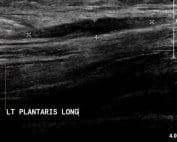
A 32 year-old male presents to the Emergency Department after he felt a “pop” in his posterior-medial calf while playing tennis. He was able to ambulate but had pain with plantar flexion and was unable to continue playing tennis. What is your differential diagnosis? What physical exam maneuver would you perform? What findings would you expect on physical exam? What is the diagnosis based on ultrasound images? What is your management in the emergency department? [+]