


ALiEM AIR Acute Coronary Syndrome Module
Welcome to the Acute Coronary Syndrome (ACS) Module! After carefully reviewing all relevant posts from the top 50 sites of the Social Media Index, the AIR Team is proud to present the highest quality online content related to ACS emergencies. 13 blog posts within the past 12 months (as of July 2018) met our standard of online excellence and were curated and approved for residency training by the AIR Series Board. We identified 2 AIR and 11 Honorable Mentions. We recommend programs give 5.5 hours (about 25 minutes per article) of III credit for this module. [+]

Case of a Lethargic Child: Developing a Differential Diagnosis
A 2-year-old previously healthy boy presents to the emergency department (ED) acting sleepier than usual. Yesterday, he was in his usual state of health, but this morning he didn’t wake up at his usual time of 6 am. When his father went to his room at 7 am, the child was lying in bed. He opened his eyes to look at his father, but did not get out of bed. The mother and father deny any trauma, fever, or seizure activity. [+]
How to Cite Podcasts, Videos, and Blogs in a Publication (AMA 10th edition)
Updated on 2-28-24 based on the AMA Manual of Style (11th edition, 2020) As medical education podcasts, videos, and blogs continue to grow in popularity it is crucial that we cite them correctly in traditional publications, specifically journal articles and textbook chapters. In a previous blog post, I described a format for citing these works on a CV. The American Medical Association (AMA) Manual of Style is in its 10th edition, with the last update being published in 2007,1 largely before the tidal wave of “nontraditional” publications. Based on the AMA Manual of Style, how should we reference these [+]
Education Theory Made Practical (Volume 2): An ALiEM Faculty Incubator eBook Project
The ALiEM Team is delighted to announce yet another eBook publication: the second volume in the Education Theory Made Practical series. This book was a labor of love written by the 2017-18 Faculty Incubator class. We are very proud of all our Faculty Incubator alumni who made this happen. Their hard work has been compiled in this FREE, peer-reviewed eBook. We sincerely feel that it will be useful for all the educators out there, wrestling with the issue of integrating theory into practice. Special shout out to Dr. Anthony Artino (@mededdoc) for providing us a really thought-provoking foreword. [+]

SAEM Research Learning Series Podcast: Writing Specific Aims for a Grant
In this installment of the SAEM Research Learning Series, co-hosts Dr. Mary Haas and Dr. Nate Haas interview Dr. Michael Puskarich (Associate Professor and Research Director at Hennepin Medical Center), who is an accomplished researcher [Google Scholar citations] on the metabolic response of humans to severe sepsis. This podcast takes a deep dive into the topic of writing specific aims for your research grant proposals. These do’s and don’ts can make or break one’s application. [+]
ALiEMU Capsules Module 11: Acute Agitation
We are proud to present Capsules Module 11: Acute Agitation, now published on ALiEMU. We present a summary of the module with key points from a stellar module by PharmDs Jenny Koehl, Kyle DeWitt, Gabrielle Procopio, and Zlatan Coralic. When you’re finished, head over to the Capsules page for even more practical pharmacology for the EM provider. [+]
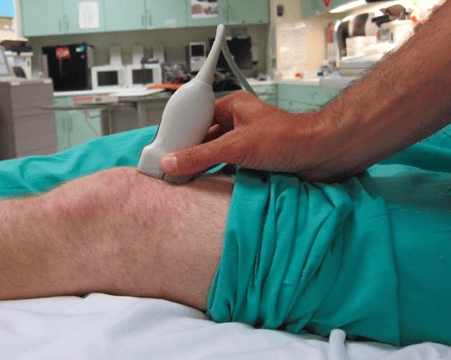
Use of Point-of-care Ultrasound in Tibial Plateau Fractures | Case Presentation
A 70-year-old female with no past medical history was hit by a motor vehicle while crossing the street. She experienced no head strike or loss of consciousness, however she was unable to ambulate at the scene, and upon arrival to the ED, complained of left knee pain. The emergency physician noted moderate swelling on exam with intact skin and distal pulses. She was tender to palpation over the proximal tibia. Portable 2-view radiographs were obtained and interpreted as “no acute fracture.” On repeat examination, however, the patient continued to have pain and was now unable to bear weight on the [+]

SAEM is teaming up with us and exclusively sponsoring the AIR Series
The Society of Academic Emergency Medicine (SAEM) is now the exclusive, multi-year sponsor of the Approved Instructional Resources (AIR) Series! This series has curated and graded open-access blog posts and podcasts in the field of EM since 2014 to identify and provide high quality, social media-based, educational resources for EM residents. It is one the most used resources for Individualized Interactive Instruction (III) credit, and plus it is free! We look forward to working more with SAEM, who shares our grand vision for medical education. This aligns perfectly with our recently re-launched ALiEMU "be free to learn" learning management platform, [+]

Reversing Anticoagulation to Administer Systemic Fibrinolytics for Ischemic Stroke: Pump the Brakes
Care of acute ischemic stroke patients is a complex and time-sensitive team effort. There is a potentially dangerous trend in the medical literature over the past few years that seems to be increasing as of late: reversing anticoagulation in order to administer systemic thrombolytic therapy. The purpose of this post is to highlight the available literature on this topic, specifically related to the direct acting oral anticoagulants (DOACs), and discuss why we should not support this practice (at least as of today). [+]

TLDR Book Review: “Talk Like TED”
Welcome back to TLDR, where our motto is: “We read books so that you have time for Netflix.” Our premise is that most self-help, parenting, education, and life-coaching books are like chicken nuggets: 2% meat and 98% filler! This month’s book is more like cafeteria meatloaf. No matter! We’re still committed to extracting a few nutritious bits from all those ground-up gym mats. We picked through the fluff and pulled out 5 gems that are worth sharing. In his book “Talk Like TED,” Carmine Gallo promises that you too can present like a TED speaker. How do you do it? [+]