



Trick of the Trade: Topical Treatment of Cannabinoid Hyperemesis Syndrome
A 23-year-old female with no past medical history presents to the ED for the 4th time this month complaining of severe “10-out-of-10” abdominal pain, nausea, and intractable vomiting. She denies alcohol use, but reports she has smoked at least 1 marijuana “bud” daily for the last 3 years. In an attempt to relieve her symptoms, she has increased her marijuana use, however she has found that her pain is actually increasing, and the only thing that appears to help is taking a hot shower or bath. With this statement, the provider immediately considers cannabinoid hyperemesis syndrome (CHS). [+]
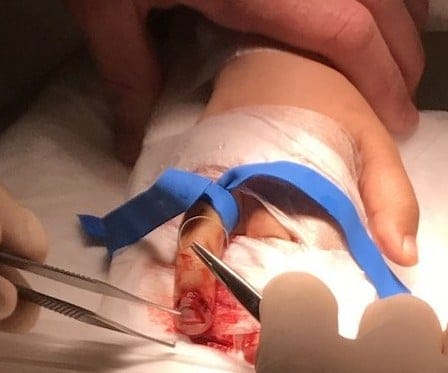
Pediatric Trick of the Trade: Finger Immobilization Technique
A 3 year-old boy presents with a deep laceration of the distal phalanx, through the nail bed, after slamming his fingers in a car door. He is crying, anxious, and uncooperative. How do you make this situation easier to evaluate and repair? Nail bed and finger laceration repairs can be challenging, and even more challenging in young patients. Preparation is key to getting a good outcome. Here we present a pediatric trick of the trade on immobilizing a finger for digit or nail bed procedures. [+]
MEdIC Series: The Case of the Difficult Debrief – Expert Review and Curated Community Commentary
Our second case of season 5, The Case of the Difficult Debrief, presented the scenario of a budding simulation educator who had a difficult experience debriefing a cohort of learners. This month’s case was developed in collaboration with the team at Simulcast, an excellent simulation website operated by a team of emergency providers in Australia, whose work includes a online Journal Club based loosely on the MEdIC discussion concept. After reviewing this commentary, we encourage readers to check out their podcast that delves into some of the issues that arose from this month’s MEdIC case. The MEdIC team (Drs. Tamara McColl, [+]

AIR-Pro: Neurology
Welcome to the Neurology AIR-Pro Module. Below we have listed our selection of the 7 highest quality blog posts related to 4 advanced level questions on neurology topics posed, curated, and approved for residency training by the AIR-Pro Series Board. The blogs relate to the following questions: Intracranial hemorrhage Diagnosis of subarachnoid hemorrhages Management of subarachnoid hemorrhages Vertigo [+]

Template for Writing a Successful Journal Manuscript
Across the health professions, it is often assumed that medical students, residents, and faculty inherently absorb the knowledge on how to construct a successful journal manuscript. That is a fallacy. Crafting a clear and logical message that presents one’s data and conclusions can be incredibly challenging. Dr. Craig Newgard, Oregon Health & Sciences University (OHSU), shares his recipe for success in an itemized fashion. He also reviews this template in a recent podcast with the SAEM Research Learning Series. [+]

IDEA Series: Intern Olympics, a Capstone Competition
The Problem Emergency medicine (EM) interns begin residency with variable clinical, procedural, and interprofessional skills. Residency leadership can find it challenging to ensure that a new class cohesively transitions into a program and community. Following a 4-week “Intern Boot Camp,” a capstone competition, “Intern Olympics,” was held to emphasize key knowledge and skills for interns. [+]
MEdIC Series: The Case of the Difficult Debrief
Welcome to season 5, episode 2 of the ALiEM Medical Education in Cases (MEdIC) series! Our team (Drs. Tamara McColl, Teresa Chan, John Eicken, Sarah Luckett-Gatopoulos, Eve Purdy, Alkarim Velji, and Brent Thoma) is pleased to welcome you to our online community of practice where we discuss the practice of academic medicine! This month’s case was developed collaboratively with the team at Simulcast. For the unacquainted, Simulcast is an excellent simulation website operated by our Australian colleagues that even includes a Journal Club set-up based loosely on the MEdIC discussion concept. Check it out following the completion of the case for a podcast that will delve into [+]
Introducing the SAEM Research Learning Series Podcasts: An ALiEM-SAEM Collaboration
ALiEM is teaming up with the Society for Academic Emergency Medicine (SAEM), which now offers live online education on emergency medicine research topics through its Research Learning Series. The ALiEM podcast team will work with SAEM content experts to deliver this high-yield research content in audio form! Check out the first example of this collaboration (“Being a Good Research Mentor and Mentee”) and be sure to listen to our next installment later this month. [+]
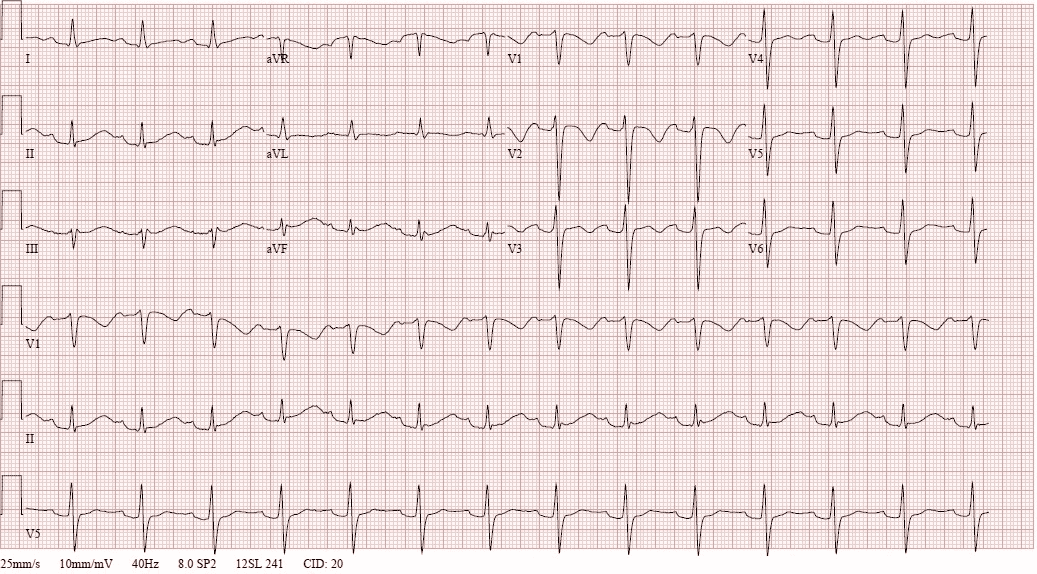
ACMT Toxicology Visual Pearls: Drug-Induced QT Prolongation
Which over-the-counter medication can be associated with these EKG findings in overdose? Aspirin Guaifenesin Loperamide Pseudoephedrine Senna [+]

Ryan Marino, MD
Division of Medical Toxicology
Department of Emergency Medicine
University Hospitals Cleveland
@ryanmarino

MEdIC Series: The Case of the Discriminatory Patient – Expert Review and Curated Community Commentary
Our first case of this season, The Case of the Discriminatory Patient, outlined a scenario of a junior resident faced with blatant discrimination while trying to treat a patient who refuses to be seen by a “non-white” or “non-Canadian” physician. This month, the MEdIC team (Drs. Tamara McColl, Teresa Chan, Sarah Luckett-Gatopoulos, Eve Purdy, John Eicken, Alkarim Velji, and Brent Thoma), hosted an online discussion around this case with insights from the ALiEM community. We are proud to present to you the curated community commentary and our expert opinions. Thank-you to all participants for contributing to the very rich discussions surrounding this [+]