


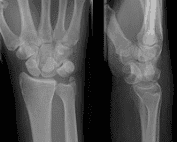
SplintER Series: A Case of Traumatic Wrist Pain After Fall on Outstretched Hand
A 46 year-old male presents with wrist pain after sustaining a mechanical fall and catching himself on his outstretched hand. An anteroposterior (left) and lateral (right) plain films of the wrist are obtained (photo credit). What is the diagnosis (hint – there are 2 findings), injury classification system, associated findings, and the recommended management plan? [+]

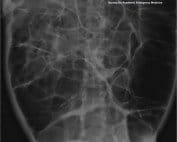
SAEM Clinical Image Series: Distended Bowels
[Click for larger view] Chief Complaint: Abdominal distention History of Present Illness: A 36-year-old male with a history of cerebral palsy, gastrointestinal dysmotility, epilepsy, hypertension, gastroesophageal reflux disease, and insomnia presents to the ED after referral by his family physician for a 3-day history of abdominal distention. Due to the patient’s neurological disorder, he is unable to communicate but is accompanied by his mother who provides his medical history. The patient’s mother states that he had a loose bowel movement this morning, which is normal for him. He has had a history of bowel problems [+]
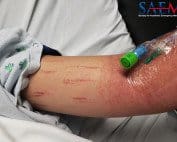
SAEM Clinical Image Series: Rash with Blood Pressure Cuff Inflation
[Click for larger view] Chief Complaint: Possible seizure, Left arm rash History of Present Illness: A 29-year-old with a history of migraine headaches, thalassemia of unknown phenotype, and no history of hypertension or epilepsy arrived to the emergency department via ambulance after possible seizure. The patient had nausea and vomiting the morning after a night of heavy drinking. After several rounds of vomiting, she felt shaky, lightheaded and experienced paresthesia in both of her hands and feet. There was no loss of consciousness, confusion or incontinence. EMS reported hypertension and tremors with upper extremity spasms. [+]
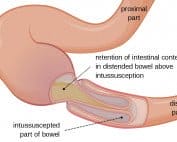
Pediatric Point of Care Ultrasonography ALiEMU Course on Intussusception
Our ALiEMU learning management system, which currently houses the AIR series, Capsules series, and In-Training Exam Prep courses, is ready to slowly open the doors to welcome external authors with high quality content. We are thrilled to welcome a UCSF-sponsored pediatric emergency medicine (EM) point of care ultrasonography (POCUS) series, led by Dr. Margaret Lin. The first course is on the intussusception scan, filled with multiple ultrasound scans showing normal variants and two different types of intussusception. [+]
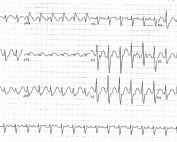
ACMT Toxicology Visual Pearls: Abnormal ECG
This abnormal ECG would be typical following an overdose on which of the following medications? Amitriptyline Buspirone Citalopram Haloperidol [+]

Colin O'Neill, MD
Carolinas Medical Center, Charlotte, NC
Latest posts by Colin O'Neill, MD (see all)
- ACMT Toxicology Visual Pearls: Abnormal ECG - June 26, 2019

ALiEM AIR | Cutaneous 2019 Module
Welcome to the AIR Cutaneous Module! After carefully reviewing all relevant posts from the top 50 sites of the Social Media Index, the ALiEM AIR Team is proud to present the highest quality online content related to cutaneous emergencies. 6 blog posts within the past 12 months (as of February 2019) met our standard of online excellence and were curated and approved for residency training by the AIR Series Board. We identified 3 AIR and 3 Honorable Mentions. We recommend programs give 3 hours (about 30 minutes per article) of III credit for this module. [+]

New PECARN Febrile Infant Rule: A 3-Variable Approach for Ages 29-60 Days | Interview with Dr. Kuppermann
The diagnosis and risk stratification of febrile young infants continues to present a clinical challenge. Serious bacterial infection (SBI) rates in infants ≤60 days have continued to be reported between 8-13%. Despite several different classification rules and pathways, we continue to struggle to accurately delineate which infants have SBI and which do not. A paper titled “A Clinical Prediction Rule to Identify Febrile Infants 60 days and Younger at Low Risk for Serious Bacterial Infections” was published in JAMA Pediatrics in February of 2019.1 The authors sought to derive a new clinical prediction rule for infants with fever. The research [+]
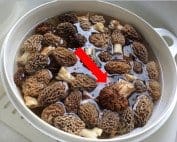
ACMT Toxicology Visual Pearls: Eating Foraged Wild Mushrooms
What clinical symptoms would be expected after eating a meal made with the pictured foraged wild mushrooms? Bradycardia, urinary incontinence, and bronchospasm Hallucinations Seizures and rhabdomyolysis Skin flushing and palpitations [+]

Alayna Prest, MD
Department of Emergency Medicine
Indiana University School of Medicine
Latest posts by Alayna Prest, MD (see all)
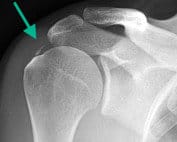
SplintER Series: A Case of Severe Shoulder Pain
A 45 year old woman presents with several days of gradually worsening right shoulder pain and stiffness. Her shoulder is very warm to the touch but not erythematous. You obtain shoulder x-rays and see a linear density in the AP view (photo credit). What is the most likely diagnosis, the differential diagnosis, and management plan? [+]

Ultrasound Gel Warmers in the Emergency Department?
How many times have you told a patient “The gel will be cold?” How many times have you watched a patient retract from the transducer because of the cold gel? How about a pediatric patient? Could warm gel improve your rate of clinically successful scans? It seems easy enough to install gel warmers alongside our ultrasound machines. But, should we do this? Read more

Director of Growth, Strategic Alliance Initiative, Center for Innovation and Digital Health
Massachusetts General Hospital;
Chief Scientific Officer, Conductscience.com
Latest posts by Shuhan He, MD (see all)
- The Discharge Severity Index: Early Research on ED Readmission Risk Assessment - August 14, 2025
- Suboxone and the Emergency Physician: Get Waivered Training - August 12, 2022
- A Tale of Two Epidemics: COVID-19 and the Opioid Crisis - April 23, 2020