



Safety and Efficacy of Clevidipine for Acute Blood Pressure Control
Background Rapid and precise control of blood pressure is vital for patients with a hypertensive emergency or an acute stroke. Commonly, nicardipine is utilized in these situations, with nitroprusside being a less appealing alternative. The most recent AHA/ASA Acute Ischemic Stroke Guidelines, updated in 2019, also recommend clevidipine as a first-line antihypertensive option [1]. Clevidipine is a dihydropyridine calcium channel blockers, similar in mechanism to nicardipine and amlodipine. The main advantage of clevidipine over nicardipine is related to its pharmacokinetics (Table 1). Given its shorter half-life of elimination, clevidipine can be titrated every 1-2 minutes. Additionally, if hypotension does occur, [+]

Droperidol for Agitation in Older Adults in the Emergency Department
Droperidol is safe and effective for the treatment of severely agitated patients in the ED [1-3]. But what about its use for agitation in elderly patients specifically? Droperidol Efficacy Two Australian studies evaluated droperidol in more than 200 older adults (≥ 65 years old) in the prehospital and ED settings [4,5]. Both studies found droperidol to be effective in elderly patients with acute behavioral disturbances. The median time to sedation was ~20-30 minutes with doses ranging from 2.5-10 mg (Table 1). Characteristic Page, et al (n=162) Calver, et al (n=47) Median Age 78 years 81 years Initial Droperidol IM Dose [+]
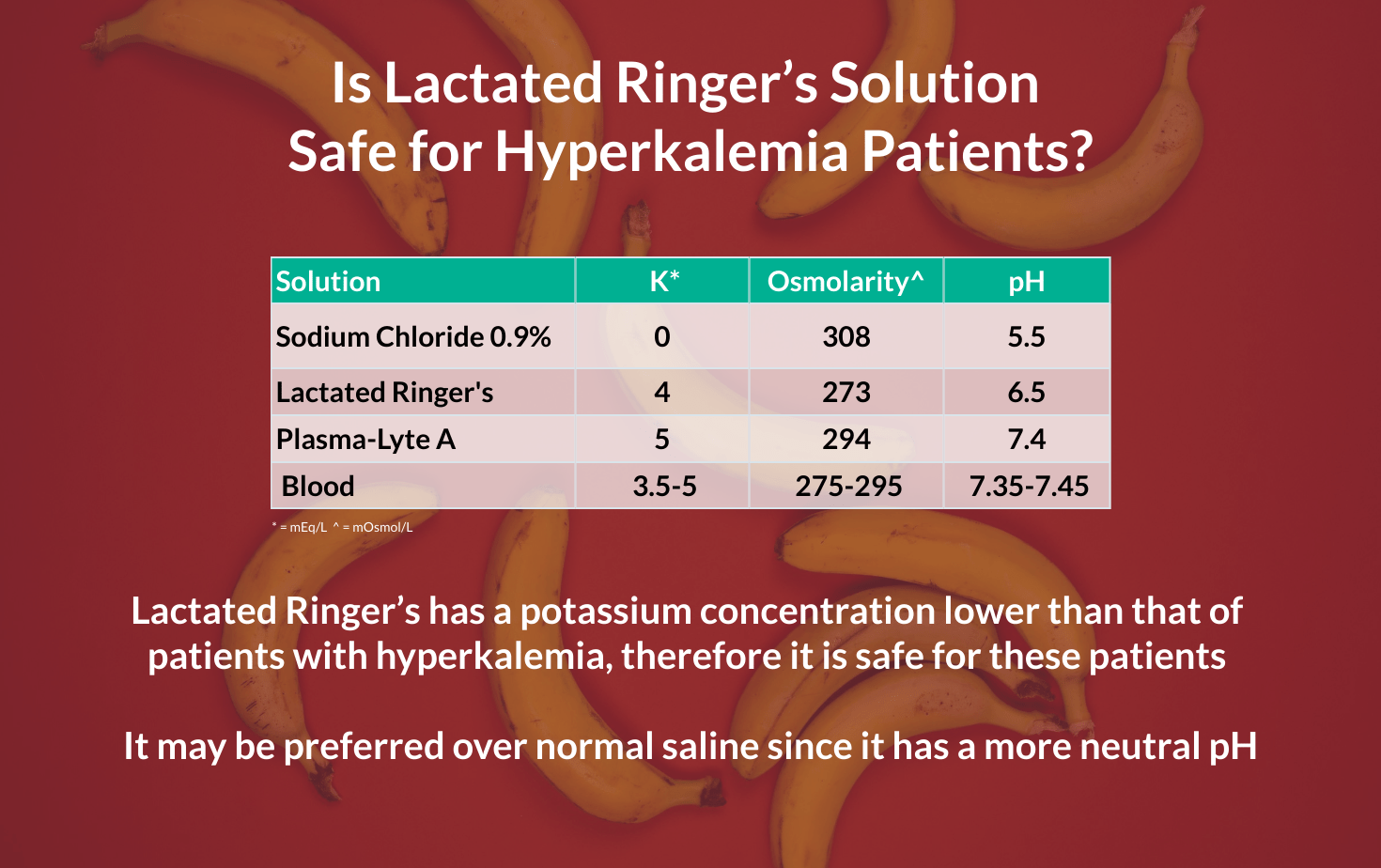
Is Lactated Ringer’s Solution Safe for Hyperkalemia Patients?
Background There are three primary fluids used for resuscitation, each contains varying amounts of potassium per liter (Table 1): 0.9% Sodium Chloride (normal saline) Lactated Ringer’s solution Plasma-Lyte A Additionally, these fluids contain markedly different amounts of other electrolytes, some of which directly influence their pH (Table 1). Solution Na* Cl* K* Ca* Lactate* Acetate* Osmolarity^ pH Sodium Chloride 0.9% (normal saline) 154 154 - - - - 308 5.5 Lactated Ringer’s 130 109 4 2.7 28 - 273 6.5 Plasma-Lyte A 140 98 5 - 27 294 7.4 Blood 135-145 96-106 3.5-5 8.5-10.5 0-1 NA 275-295 7.35-7.45 Table 1: [+]

ALiEM AIR Series | Environmental 2021 Module
Welcome to the AIR Environmental Module! After carefully reviewing all relevant posts from the top 50 sites of the Social Media Index, the ALiEM AIR Team is proud to present the highest quality online content related to environmental emergencies in the Emergency Department. 6 blog posts within the past 12 months (as of January 2021) met our standard of online excellence and were curated and approved for residency training by the AIR Series Board. We identified 3 AIR and 3 Honorable Mentions. We recommend programs give 3 hours (about 30 minutes per article) of III credit for this module. AIR [+]

ACMT Toxicology Visual Pearls – In “Spore” Taste
A 15-year-old male presents symptomatic several hours after inhaling spores of this mushroom as a home remedy for epistaxis. What is the presentation and pathophysiology of the toxic syndrome associated with this mushroom? For a video of this mushroom in action: https://youtu.be/G_DXTlvvsco Dyspnea and cough from hypersensitivity alveolitis Flushing, nausea and vomiting from acetaldehyde accumulation Nausea, vomiting and hepatoxicity from RNA synthetase inhibition Seizures from reduced GABA production in the central nervous system [+]

EMRad: Can’t Miss Pediatric Elbow Injuries
Have you ever been working a shift at 3 am and wondered, “Am I missing something? I’ll just splint and instruct the patient to follow up with their PCP in 1 week.” This can be a reasonable approach, especially if you’re concerned there could be a fracture. But we can do better. Enter the “Can’t Miss” series: a series organized by body part that will help identify common and catastrophic injuries. This list is not meant to be a comprehensive review of each body part, but rather to highlight and improve your sensitivity for [+]

SplintER Series: Kitty Nibble: A Case of the Sausage Finger
A 30-year-old female presents with left second finger pain with overlying erythema, warmth, and swelling the day after her cat bit her finger. She cannot fully extend the finger, it is tender and she has pain when it is passively extended. Her hand appears as shown above (Figure 1. Case courtesy of Kristina Kyle, MD). [+]

SplintER Series: A Case of Hip Pain
Figure 1. Image prompt: AP view of the pelvis and left hip. Authors’ own images. A 70-year-old male presents with left hip pain and inability to ambulate after a mechanical trip and fall. Examination demonstrates that the left lower extremity is shortened, abducted and externally rotated. Hip and pelvis x-rays are obtained (Figure 1). [+]
ALiEM AIR Series | Gastroenterology 2020 Module
Welcome to the AIR Gastroenterology Module! After carefully reviewing all relevant posts from the top 50 sites of the Social Media Index, the ALiEM AIR Team is proud to present the highest quality online content related to gastroenterology in the Emergency Department. 6 blog posts within the past 12 months (as of November 2020) met our standard of online excellence and were curated and approved for residency training by the AIR Series Board. We identified 1 AIR and 5 Honorable Mentions. We recommend programs give 3 hours (about 30 minutes per article) of III credit for this module. AIR Stamp [+]

Teaching LGBTQ+ Health: 10 Clinical Pearls
Are you confident in your skills when taking care of LGBTQ+ patients? Are you able to teach principles of LGBTQ+ health to trainees in your clinical practice and the classroom setting? Learners across the health professions demand improved LGBTQ+ health content and additional training opportunities in their schools’ curricula. However, most clinician educators received little, if any, training in LGBTQ+ health when they were students. 10 Clinical Pearls on Teaching About LGBTQ+ Health The following are some sneak-peak clinical pearls from the Teaching LGBTQ+ Health online course that just launched. This open access, interactive, CME course was published in conjunction [+]

Director of Growth, Strategic Alliance Initiative, Center for Innovation and Digital Health
Massachusetts General Hospital;
Chief Scientific Officer, Conductscience.com
Latest posts by Shuhan He, MD (see all)
- The Discharge Severity Index: Early Research on ED Readmission Risk Assessment - August 14, 2025
- Suboxone and the Emergency Physician: Get Waivered Training - August 12, 2022
- A Tale of Two Epidemics: COVID-19 and the Opioid Crisis - April 23, 2020