


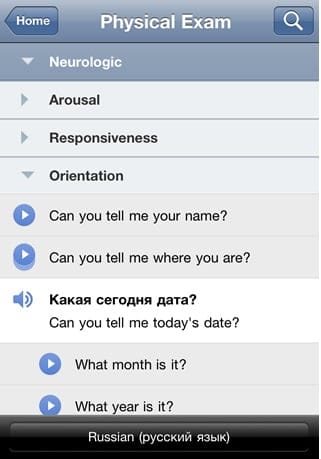
Hot off the press: MediBabble app
Ever since my post about the top medical apps, I have been inundated with people asking me to review their apps. One has stood out. Medibabble is a real-time medical translation app and is now available for FREE. It was created by two innovative UCSF medical school graduates, Dr. Alex Blau and Dr. Brad Cohn. This app contains an extensive preset list of history questions and physical exam commands. When you click on a sentence, the app will translate and speak the sentence in one of 5 languages (Spanish, Cantonese, Mandarin, Russian, and Haitian Creole). [+]
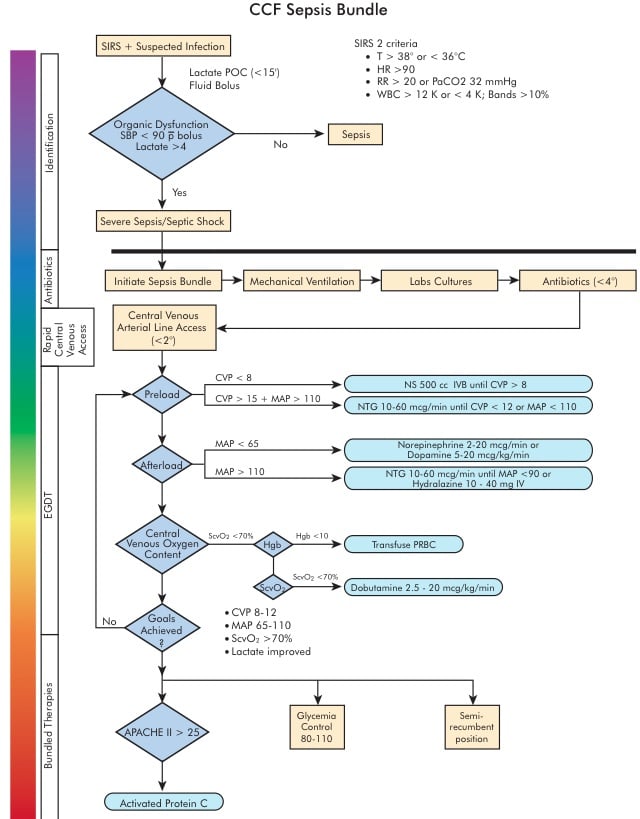
Trick of the Trade: Serial lactate measurements in sepsis?
Does your Emergency Department have computerized spectrophotometric catheters to measure continuous central venous oxygen saturation (ScvO2) in early goal directed therapy (EGDT) for severe sepsis? That’s what was used in the original Rivers’ EGDT study. I’ve never even seen one before. [+]

EMRAP Education Podcast: Educational Resources in EM
Dr. Rob Rogers has posted his 21st podcast on EMRAP Educator’s Edition. The topic is “Educational Resources in Emergency Medicine”. Listen to why you need to know about these resources: [+]

Director of Growth, Strategic Alliance Initiative, [+]

Trick of the Trade: Conveying risk for postexposure prophylaxis
A health care worker hurried in to the ED after being poked with a needle. ‘It was an old 18G needle with dried blood’, she said. Her puncture had drawn blood. You discussed the very low risk of contacting HIV and the side effects of postexposure prophylaxis (PEP). She asked, ‘What does very low risk mean?’ Is there another way to covery risk for patients? [+]
Didactic videos for rotating residents the ED
Many academic Emergency Departments are staffed by non-EM residents. Dr. Amer Aldeen and his super-star team from Northwestern created NURRC Modules (Northwestern University Rotating Resident Curriculum). These modules allow the off-service residents, who all have different schedules, to learn key EM-based topics at their own leisure and convenience. The positive effect of the curriculum on the off-service residents’ medical knowledge was recently published in Academic Emergency Medicine [+]

Article review: How competent do trainees feel?
It is 2 a.m. You, the resident, have just spoken to your staff/attending, who told you to do a task. You have seen one, but don’t feel comfortable doing one independently. Will you tell your staff/attending about how you feel? What if the patient did poorly after that? This study examines the perception of EM trainees of their competence and adverse events and how they feel about reporting them. [+]

The Superbowl of Blogs: Vote us for "Best Clinical Sciences Blog"
Medgadget annually hosts a contest for the best medical blogs. It’s the Superbowl of blogs. Our blog was nominated for the Best New Medical Blog last year, but got our butt kicked. This year, we’re honored to be a finalist in the Best Clinical Sciences Blog category. That’s the great news. Unlucky for us, we are in the same category as the juggernauts EMCrit (also nominated in the overall Best Medical Blog category) and Resus.M.E. I do love the fact that the EM specialty is dominating with 3 finalists in this list of 5. [+]

Paucis Verbis: Management of Accidental Hypothermia
With all of the amazing, sunny weather here in California, I feel (briefly) terrible for all those braving the snowpocalyptic conditions across the United States. So, in honor of all those bundled up and shivering, I wanted to review the management of accidental hypothermia. Tip: Avoid jostling the hypothermic patient too much because of myocardial irritability. Don't send your patient into an arrhythmia. PV Card: Management of Accidental Hypothermia Go to ALiEM (PV) Cards for more resources.

School Sucks: Building a new culture of teaching and learning
In his talk (subtitled “School Sucks”), Northwestern University Physics Professor Dr. Tae describes how he would improve math and science education. While this is directed at college studies, some of the concepts are applicable to teaching Emergency Medicine. He shares a lot of great insight, but I wanted to focus on one concept in particular: The secret to learning = “Work your ass off until you figure it out.” [+]
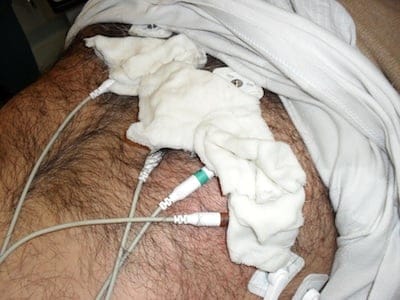
Trick of the Trade: Getting an EKG on Chewbacca
Patients with a hairy chest may require little patches of hair to be shaved when applying EKG leads. This allows the leads to stick firmly to the chest. Loose leads will result in either an artifactual signal or no signal at all on the EKG machine. How can you obtain an EKG without shaving little patches on the patient’s chest? [+]