



Trick of the Trade: Topical anesthetic cream for cutaneous abscess drainage in children
Abscess drainage can be painful and time consuming in the ED. Can this article help? 1 Trick of the Trade Apply a topical anesthetic cream on skin abscesses prior to incision and drainage (I and D). In this press-released article in American Journal of Emergency Medicine, the authors found that application of a topical 4% lidocaine cream (LMX 4) was associated with spontaneous cutaneous abscess drainage in children. [+]

Article Review: Emergency physicians interruptions
What exactly do ED attendings do on shift? This novel prospective, time-motion study tracks the activities of ED attendings at 2 academic and 2 community sites. All sites used paper charting in the ED and computerized medical records for labs and radiology results. [+]


Paucis Verbis: Right and posterior ECG leads
A standard 12-lead ECG can be very telling for patients with chest pain or shortness of breath. A right ventricular (RV) and posterior wall infarct, however, can present very subtly. You can obtain special right-sided (V1R-V6R) and posterior leads (V7-V9), if you are concerned. What are the indications for obtaining right-sided and posterior ECG leads? Go to the ALiEM Cards for more resources. Addendum 3/11/11: Right sided ECG leads (V1R-V6R) are positioned in a mirror image fashion from the standard 12-lead precordial leads. Posterior ECG leads (V7-V9) are applied by moving V4-V6 in the posterior positions.

Trick of the Trade: Heat it up!
What is it about heat that makes everything feel better? Fireplace, hot tub, heat packs, electric blankets, and hot chocolate have got to be the best inventions EVER. How can we apply this in Medicine? [+]
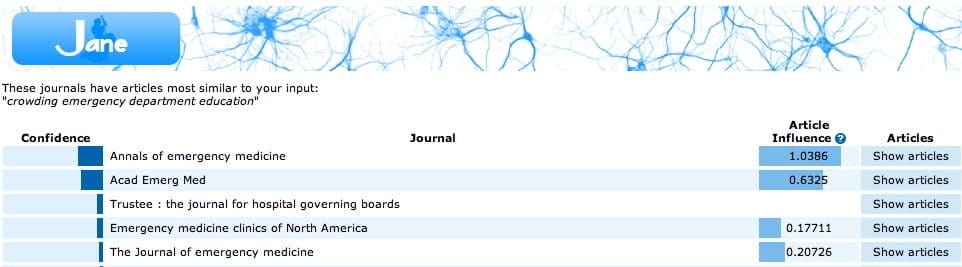
Finding the right journal for your manuscript
When writing a manuscript, how do you choose what journal to submit to? You should factor in the journal’s impact factor and your manuscript content. At the recent CORD Academic Assembly meeting, I learned of a website which helps you decide your journal. JANE: Journal/Author Name Estimator [+]

Trick of the Trade: Website resource on HIV medications
At our department’s first annual UCSF High Risk Hawaii Conference 2 weeks ago, Dr. Rachel Chin taught about complications from all of the HIV drugs on the market now. It’s a virtual alphabet soup: EFV, TDF, FTC, oh my. How do you keep track of them all? [+]

Hot off the press: Clinical practice guideline for ketamine in the ED
A 3 year old girl is brought into the ED with an abscess to her groin. Upon examination it is fluctuant and needs incision and drainage. Next door is a 5 year old boy, who fell off his bed and has an angulated radius fracture that needs reduction. Hhhmmmm…how to manage these patients? Local anesthesia? Hematoma block? Nothing (aka brutacaine)? What about ketamine, that seems popular these days. IV? IM? With or without atropine? So many decisions! Luckily you were surfing the internet one night and came across the 2011 clinical practice guideline on ketamine in the ED, which was [+]
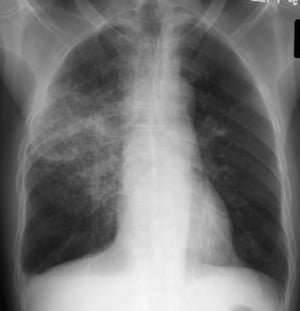
Paucis Verbis: Pneumonia risk stratification tools
Pneumonia is a common cause for ED visits. How do you decide on whether the patient can be managed as an outpatient or inpatient? To supplement your clinical judgment, many clinicians use the Pneumonia Severity Index (PSI) score. Have you heard of CURB-65, supported by the British Thoracic Society? What about SMART-COP, which is meant to help you predict if your patient will need Intensive Respiratory or Vasopressor Support (IRVS)? PV Card: Risk Stratification Scoring Tools in Pneumonia Go to the ALiEM Cards for more resources.
Article Review: Professionalism of physicians on Twitter
In a Research Letter in JAMA, Dr. Chretien et al describe the profile of physicians in the Twitter universe, specifically focusing on professionalism.Inclusion criteria: Self identified physician At least 500 followers during May 1-31, 2010 (Whew, I only have 309 followers.) English tweets Posted a tweet within last 6 months [+]

Paucis Verbis: Assessing patients with suicidality in the ED
Dr. Rob Orman emailed me last week about creating a pocket card on Suicide Risk Stratification. In many community ED's, risk assessment is done by the emergency physician. I'm lucky where I work, because we have a 24/7 psychiatric ED, which consults on suicidal patients in the "medical ED". In the end, assessment is primarily based on physician judgment, because there's no great clinical decision tool, rules, or scores to assess risk. Rob has created his own mnemonic to help you ask the right questions in assessing a suicidal patient. This is a sneak peek into a larger article that [+]