



Atraumatic Low Back Pain: ACEP E-QUAL Network Podcast
Atraumatic low back pain is a common complaint in the ED. For most patients, a thorough history and physical exam is sufficient to exonerate causes that threaten life or neurological function. For a small subset, however, MRI may be required. ALiEM has partnered with the ACEP E-QUAL Network to promote clinical practice improvements through a series of podcasts. In our first installment, we focus on this common presentation. We review highlights from an interview with Dr. Jonathan Edlow, Vice Chair of Emergency Medicine at Beth Israel Deaconess, about the presentation and evaluation of low back pain. Afterward be sure to check [+]
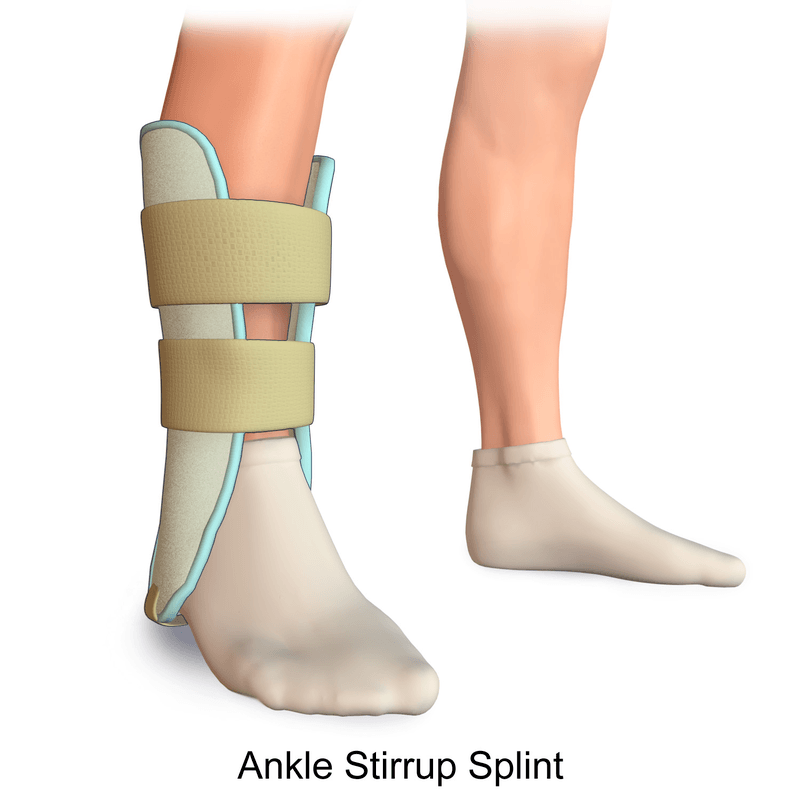
SplintER Series: Splint Principles 101
Why do we splint? Splinting is one of the fundamental procedures of the Emergency Department (ED). How well-versed are we with it? Why do we even splint? By the end of this post, you will know the reason why we splint, when to splint, and just as importantly — when NOT to splint in the ED. [+]

SplintER: A New on Orthopedic Injuries and Splinting
The purpose of the SplintER series is to teach the fundamentals and introduce advanced concepts of splinting to the Emergency Medicine (EM) professional. Humans have been splinting their injuries since 1300 B.C.1 Although the fundamentals have not changed, splint selection and application require some thoughtful consideration. A 2017 prospective, observational study in the Journal of Pediatric Orthopaedics demonstrated that more than 90% of splints applied in the Emergency Department were inappropriate (30% applied by EM attendings), as evaluated by orthopaedic surgeons.2 While that number may not be representative in your institution, it certainly highlights the inadequacies that many of us feel [+]
Extensor Tendon Lacerations to the Foot
A young man is brought into an emergency department after an electric lawn edger cut through his work boot and into the dorsum of his right foot. He has a clearly contaminated 5 cm x 1 cm laceration on the lateral side, and an underlying tendon is exposed. Sensation is diminished around the wound and he is unable to actively extend his 5th toe past a neutral position. How would you diagnose and repair his extensor tendon injury? [+]

Update on the ED Management of Intracranial Hemorrhage: Not All Head Bleeds Are the Same
Robust and comprehensive studies now support specific management guidelines for patients presenting with different intracranial hemorrhages (ICH). From the Emergency Department perspective, the primary dilemmas involve specific blood pressure goals and whether seizure prophylaxis with phenytoin is necessary. The Brain Trauma Foundation provides an excellent summary of the current guidelines.1 [+]

William Shyy, MD
Co-Director of Emergency Ultrasound [+]

AIR Series Psychobehavioral 2017
Welcome to the Psychobehavioral Module! After carefully reviewing all relevant posts from the top 50 sites of the Social Media Index the ALiEM AIR Team is proud to present the highest quality toxicology content. Below we have listed our selection of the 2 highest quality blog posts within the past 12 months (as of June 2017) related to psychology emergencies, curated and approved for residency training by the AIR Series Board. More specifically in this module, we identified 0 AIRs and 2 Honorable Mentions. We recommend programs give 1 hour (about 30 minutes per article) of III credit for this module. As of June [+]
AIR Series: Renal/Genitourinary (2017)
Welcome to the Renal/GU Module! After carefully reviewing all relevant posts from the top 50 sites of the Social Media Index, the ALiEM AIR Team is proud to present the highest quality Renal/GU content. Below we have listed our selection of the 13 highest quality blog posts within the past 12 months (as of May 2017) related to Renal/GU emergencies, curated and approved for residency training by the AIR Series Board. We identified 3 AIRs and 10 Honorable Mentions. We recommend programs give 4 hours (about 20 minutes per article) of III credit for this module. As of June 2017, over 125 residency programs [+]

Team-Focused CPR: Bringing Pre-hospital Success to the ED
High-quality chest compressions and early defibrillation are the cornerstones of effective cardiac arrest care.1 When implemented correctly these two interventions enhance patient outcomes and improve overall survival.2 However, despite simplified advanced cardiac life support (ACLS) algorithms and extensive training of providers, cardiac arrest scenarios in the emergency department (ED) are still high-stress and mortality rates remain high.3,4 [+]

Blake Johnson, MD
Department of [+]
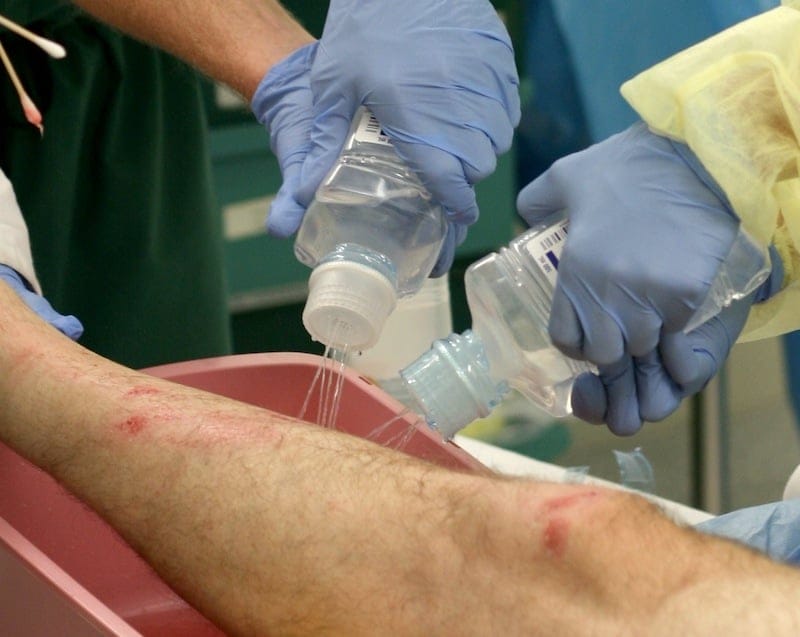
Trick of the Trade: DIY Squirt Bottle Wound Irrigation
Wound irrigation is arguably one of the most important steps in closing a laceration, because all lacerations should be considered to be contaminated. Irrigation is considered the foundation in preventing infection. A common way to cleanse a wound is to irrigate a wound using a 20 cc syringe, angiocatheter, and splash protector. To achieve 500 cc of irrigation, however, it would require 25 syringe refills! Is there a better, cost-effective alternative? [+]
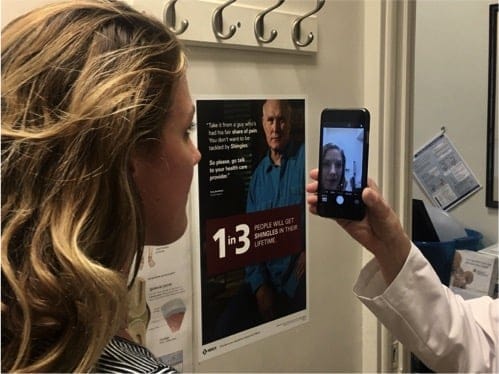
Trick of the Trade: Gaze Testing Using “Selfie Mode” on Your Smartphone Camera
The NIH Stroke Scale is used to assess the severity of a suspected stroke. It includes 11 neurologic exam components that can be quickly performed at the bedside. The second component of the NIH Stroke Scale is testing of voluntary horizontal eye movements, a.k.a., “best gaze”.1 Gaze is usually tested by instructing the patient to follow the examiner’s hand or pointer finger in a horizontal plane from side to side. This assessment assumes that the patient can comprehend instructions and actively participate in the physical exam. But… how do you test gaze if your patient is aphasic or unable to [+]

Director of Growth, Strategic Alliance Initiative, Center for Innovation and Digital Health
Massachusetts General Hospital;
Chief Scientific Officer, Conductscience.com
Latest posts by Shuhan He, MD (see all)
- The Discharge Severity Index: Early Research on ED Readmission Risk Assessment - August 14, 2025
- Suboxone and the Emergency Physician: Get Waivered Training - August 12, 2022
- A Tale of Two Epidemics: COVID-19 and the Opioid Crisis - April 23, 2020