



EM Pharmacotherapy Guidelines and Position Statements: Resource for ED Rotations
Several years ago I created a resource for my ED rotation that I share with pharmacy students, pharmacy residents, and EM physician residents. It contains most of the guidelines and position statements on EM drug therapy that I utilize most often and is updated as new iterations are published. We’d like to share this tool with you to be used/modified to meet your rotation needs. Last updated: February 22, 2018 [+]

Little Patients, Big Medicine Podcast: Lactate in Pediatric Sepsis
The first recording from Little Patients, Big Medicine: the Pediatric Emergency Medicine (PEM) Podcast. This is an exciting interview with Dr. Halden Scott, a PEM physician at Children’s Hospital Colorado, about the use of lactate measurement in pediatric sepsis. Dr. Scott is one of the premier pediatric sepsis researchers, with a specific focus on the use of lactate measurement in the ED. We talk about the Sepsis-3 definitions and whether pediatrics will eventually follow them, Dr. Scott’s previous work on lactate use in the pediatric ED, and her new article published in March of 2017 on the association between elevated [+]
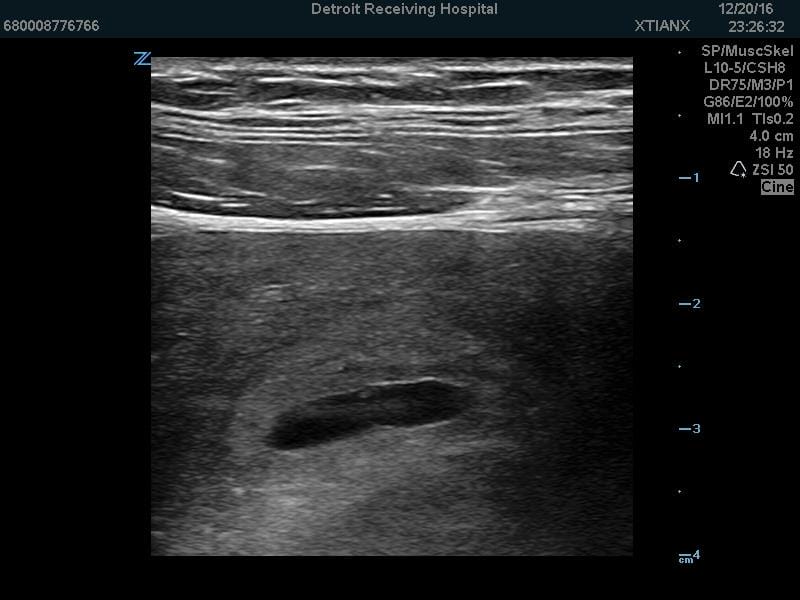
Trick: Linear Ultrasound Transducers in Intrauterine Pregnancy Evaluation
The volume of women presenting to the emergency department (ED) with newly diagnosed first-trimester pregnancies and suspected ectopic pregnancies sometimes seems like an infinitely growing number. As ED physicians, proper identification of an intrauterine pregnancy (IUP) in these patients is of paramount importance and the initial imaging test of choice for many has become bedside point-of-care ultrasound (POCUS). [+]

Beyond the Abstract | Shared Decision-Making in the ED: 3 Factors That Matter
Shared decision-making seems to be more popular than Snapchat these days. Everyone in emergency medicine is talking about it… but who is actually doing it properly? In our recent concepts piece published in Annals of Emergency Medicine, we describe 3 key factors that must be present for shared decision-making (SDM) to be appropriate in the emergency department (ED). [+]

Traumatic Bleeding in Anticoagulated Patients: 5 Other Sources Beyond the Brain
When a patient is started on anticoagulant therapy, the purpose is to prevent clot formation or propagation. Anticoagulants can improve morbidity and mortality by maintaining cardiac stent patency, reducing the propagation of pulmonary emboli, or preventing formation of intra-cardiac thrombi.1,2 Unfortunately even after minor trauma, these medications can cause major problems. When a patient on clopidogrel is in a motor vehicle collision (MVC) or an elderly patient on warfarin falls out of their bed, the once life-improving therapy becomes potentially life-threatening. It is important for emergency care providers to maintain a high index of suspicion for life-threatening bleeds in all patients on [+]
60 Second Soapbox: Shared Decision Making, Backboards, and Caring for the Family
Its’ time for another installment of 60 Second Soapbox! Each episode, one lucky individual gets exactly 1 minute to present their rant-of-choice to the world. Any topic is on the table – clinical, academic, economic, or whatever else may interest an EM-centric audience. We carefully remix your audio to add an extra splash of drama and excitement. Even more exciting, participants get to challenge 3 of their peers to stand on a soapbox of their own! [+]

Ultrasound For The Win! – 20F with First Trimester Vaginal Bleeding #US4TW
Welcome to another ultrasound-based case, part of the “Ultrasound For The Win!” (#US4TW) Case Series. In this case series, we focus on a real clinical case where point-of-care ultrasound changed the management of a patient’s care or aided in the diagnosis. In this case, a 20-year-old woman presents with first-trimester vaginal bleeding. [+]

Eunice Choi, DO
Department of Emergency Medicine
Einstein Medical [+]

PEM Pearls: Search & Rescue of Ear Foreign Bodies – Picking the Right Tool
While ear foreign bodies can happen at any age, the majority occur in children less than 7 years of age.1 The younger the patient, the less likely they are cooperative with the exam and, therefore, the less chance of successful foreign body removal. The first attempt at removal is the best, so it is important to make it count. Similarly, different types of foreign bodies call for different “tools” for removal. It is important to understand when to attempt removal in the emergency department (ED) and what tools are available. This blog post will help you optimize your first pass success at foreign body removal by [+]

ACMT Toxicology Visual Pearls: Exotic Viper Envenomation
A man was bitten twice on the dorsal radial aspect of his right hand while feeding his pet West African Bush Viper. The patient immediately tied multiple tourniquets around his right arm before presenting to the emergency department. During examination he is complaining of swelling and severe pain in his right upper extremity, but has no other complaints. What are the appropriate next steps in managing this patient? Apply ice to the bites Measure compartment pressures in the right arm and forearm Perform a fasciotomy Remove the tourniquets and order hematologic studies Use a venom extractor to reduce venom burden [+]

AIR-Pro: Gastroenterology
Welcome to the Gastroenterology AIR-Pro Module. Below we have listed our selection of the 10 highest quality blog posts related to 4 advanced level questions on toxicology topics posed, curated, and approved for residency training by the AIR-Pro Series Board. The blogs relate to the following questions: Cirrhosis and variceal bleeding Food impaction Management of diverticulitis Airway management in the gastrointestinal bleed In this module, we have 8 AIR-Pro’s and 2 Honorable Mentions. To strive for comprehensiveness, we selected from a broad spectrum of blogs identified through FOAMSearch.net and FOAMSearcher. [+]

Director of Growth, Strategic Alliance Initiative, Center for Innovation and Digital Health
Massachusetts General Hospital;
Chief Scientific Officer, Conductscience.com
Latest posts by Shuhan He, MD (see all)
- The Discharge Severity Index: Early Research on ED Readmission Risk Assessment - August 14, 2025
- Suboxone and the Emergency Physician: Get Waivered Training - August 12, 2022
- A Tale of Two Epidemics: COVID-19 and the Opioid Crisis - April 23, 2020