


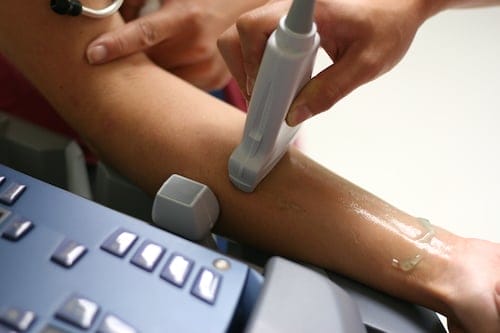
Trick of the Trade: Patient positioning for ultrasound-guided ulnar nerve block
Patients with 5th metacarpal fractures (commonly termed “boxer’s fracture”) are frequently treated in the emergency department (ED) with closed reduction and splinting. Obtaining analgesia and a successful closed reduction can often be challenging without procedural sedation. Severe swelling can make a hematoma block difficult, often resulting in inadequate analgesia. An ultrasound-guided ulnar nerve block provides a simple method to facilitate pain relief and allow for improved fracture site manipulation. [+]

Diagnose on Sight: Shortness of Breath
Case: 55-year-old restrained driver is reporting severe shortness of breath and right sided chest pain after a high-speed motor vehicle collision. Her respiratory rate is 26 breaths/min and her oxygen saturation is 96% on a 15-liter non-rebreather. She has decreased breath sounds on the right, epigastric tenderness, and an abdominal seatbelt sign. What is the diagnosis? [+]

Sarah G. Sifuentez MD
UCSF-Fresno Emergency Medicine Residency Program

Top 20 ALiEM Clinical Posts in 2015
Seasons greetings from the ALiEM team. We have been publishing so many posts this year that you may have missed a few. Did you catch at least the top 20 most-read ALiEM clinical posts, which were published in 2015? Check them out. [+]


Child Whisperer Series: Making the Most of the Holidays in the ED
“Ugh I have to work Christmas Eve and Christmas day.” “I hate not being with my family for the holidays.” “Hanukkah won’t be the same this year if I can’t be with my Dad.” “New Year’s Eve in the ED, sounds like a blast… said no one ever.” These are just a few of the comments I have heard over the last few weeks leading up to the holidays. The last one is courtesy of myself. While I complain, deep down I know it’s not so bad. If you look hard enough I have found you can find the holiday [+]
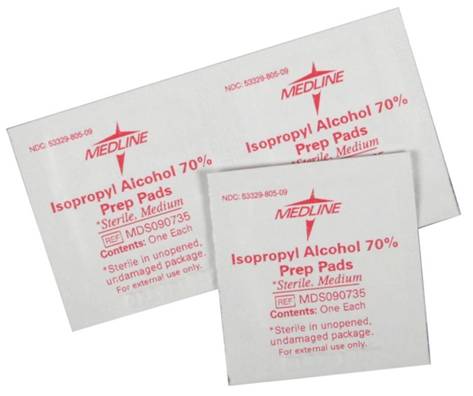
Trick of the Trade: Isopropyl Alcohol Vapor Inhalation for Nausea and Vomiting
Your triage nurse complains of numerous patients in the waiting room complaining of nausea, retching, and emesis. They ask you “why can’t we have an antiemetic on hand in triage?” Turns out they might have had an effective antiemetic on hand, or rather in their scrub pocket the entire time. They just didn’t know about it yet. [+]

PEM Pearls: Cardiac causes of pediatric chest pain
Children with chest pain commonly present to the emergency department. Both the child and family members may think their symptoms are due to a serious illness. Among adolescents seen for their chest pain, more than 50% thought they were having a heart attack or that they had cancer.1 In reality, only 6% of pediatric chest pain has a cardiac etiology.2 Nonetheless, extensive and costly emergency department (ED) evaluations are common and there is wide practice variation.3 But prior to reassuring your patient, what can you do to reassure yourself that your patient doesn’t need a more extensive workup? What would [+]

Ultrasound For the Win! Case – 55-year-old man with chest pain #US4TW
Welcome to another ultrasound-based case, part of the “Ultrasound For The Win!” (#US4TW) Case Series. In this peer-reviewed case series, we focus on real clinical cases where bedside ultrasound changed management or aided in diagnoses. In this case, a 55-year-old man presents with acute-onset chest pain. [+]

AIR Series: Environmental Module 2
Unlike the previous cardiology modules, the environmental module was comparatively under-represented in the top 50 sites of the Social Media Index. Below we have listed our selection of the 4 highest quality blog posts within the past 12 months (as of October 2015) related to environmental emergencies, curated and approved for residency training by the AIR Series Board. More specifically in this module, we identified 2 AIRs and 2 Honorable Mentions. [+]

60-Second Soapbox: Maday (Name Game), Colbenson (Knee Immobilizer), Roland (Knowledge Translation)
Welcome to the newest iteration of 60-Second Soapbox! Each episode, one lucky individual gets exactly 1 whole minute to present their rant-of-choice to the world. Any topic is on the table – clinical, academic, economic, or whatever else may interest an EM-centric audience. We carefully remix your audio to add an extra splash of drama and excitement. Even more exciting, participants get to challenge 3 of their peers to stand on a soapbox of their own! [+]

AIR-Pro Series: Trauma (2015)
Below we have listed our selection of the 6 highest quality blog posts related to 4 advanced level questions on trauma topics posed, curated, and approved for residency training by the AIR-Pro Series Board. The blogs relate to the following questions: When to give tranexamic acid in the trauma patient The pregnant trauma patient Transfusions in the trauma patient Resuscitative Endovascular Balloon Occlusion of the Aorta (REBOA) In this module, we have 6 AIR-Pro’s and we did not include any honorable mentions to prevent redundancy of the topics covered. To strive for comprehensiveness, we selected from a broad spectrum of blogs identified through FOAMSearch.net. [+]
Director of Growth, Strategic Alliance Initiative, Center for Innovation and Digital Health
Massachusetts General Hospital;
Chief Scientific Officer, Conductscience.com
Latest posts by Shuhan He, MD (see all)
- The Discharge Severity Index: Early Research on ED Readmission Risk Assessment - August 14, 2025
- Suboxone and the Emergency Physician: Get Waivered Training - August 12, 2022
- A Tale of Two Epidemics: COVID-19 and the Opioid Crisis - April 23, 2020