


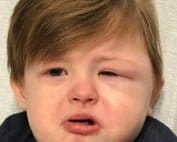
SAEM Clinical Image Series: Facial Swelling in a 2 Year Old
[Click for larger view] Chief complaint: Left-sided facial swelling History of Present Illness: A 2-year-old male presents to the emergency department in January after waking up with left-sided facial swelling. Mother states her son has had cough and congestion for the past 4 days for which she has been giving Tylenol and a children’s cough medication. The patient went to bed, awoke the following morning with facial swelling, and was brought to the emergency department. He has no allergies, history of trauma to the area, or bug bites. The patient is fully vaccinated including [+]
EM Match Advice: Program Directors Reflect on the 2019 Residency Match
The National Residency Matching Program® (NRMP) annually publishes data for the Residency Match. In this EM Match Advice episode, program directors reflect on the 2019 data for EM [PDF]. How competitive was emergency medicine (EM), especially given the transition period of having a single-accreditation system? Because it seems that EM remains modestly competitive, how many programs should one apply to and interview at? The below table outlines the data trends for 2011-2019. [+]

ACMT Toxicology Visual Pearls: Mushroom Mania
After eating the mushroom pictured, a 15-year-old patient arrives to the emergency department agitated, diaphoretic, and hallucinating, and then acutely becomes more somnolent and less responsive. Which neurotransmitter systems are affected by the toxins contained in this mushroom? Acetylcholine and histamine Dopamine and norepinephrine Gamma-aminobutyric acid (GABA) and N-methyl-D-aspartate (NMDA) Glycine and serotonin [+]

Mary Grady, MD
Department of [+]
ALiEM 2019 Gram Rounds Winner
Last month, ALiEM launched a one-of-a-kind social media contest on Instagram to find the most innovative emergency medicine residency education program. Dozens of residency programs from around the country shared incredible didactic, simulation and wellness initiatives. At the end of our contest period, one residency program stood out from the rest. Join us in congratulating the winner of ALiEM 'Gram' Rounds 2019: Loma Linda Emergency Medicine We were impressed with Loma Linda's novel approach to simulation and ability to disseminate practical clinical pearls. Be sure to visit our Instagram page @aliemteam, and check out story highlights to see all contest [+]
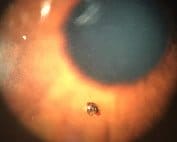
SAEM Clinical Image Series: Corneal Foreign Body
[Click for larger view] Chief complaint: Eye pain History of Present Illness: A 41-year-old man presents with pain and a foreign body sensation in the right eye since welding 4 days ago. The patient wore eye protective gear; however, he explains that he only wore sunglasses. A spark flew in from above his glasses and hit him in the right eye. The pain has been steady since. He complains of irritation exacerbated by blinking, but vision has remained unchanged. He has no other injury and no other physical complaint. [+]
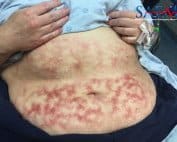
SAEM Clinical Image Series: Tea & Toast | A Case of an Abdominal Rash
[Click for larger view] Chief complaint: Abdominal pain, nausea, and vomiting History of present illness: A 46 year-old female with a past history of fibromyalgia, irritable bowel disease, and chronic abdominal pain presented to the emergency department with abdominal pain, nausea, and vomiting. She reported a one-year history of similar symptoms but states that her symptoms are worse today than usual, and not improved by her home hydrocodone, medical marijuana, or heating pad use – all of which she uses daily. She has not been able to tolerate oral intake today, vomiting up her [+]
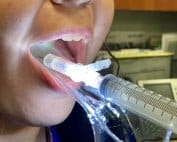
Trick: Peritonsillar abscess drainage 3.0 | All the steps with added variations
A 25-year-old medical student comes in with a muffled voice, sore throat and trismus. You look at the back of her throat and you see the uvula deviated to the right. You astutely diagnosed a peritonsillar abscess (PTA). You consider aspirating and want to check for tips on how to successfully do this.Dr. Michelle Lin and Dr. Demian Szyld have created great guides for the common and important emergency medicine procedure of draining a PTA (laryngoscope lighting and spinal needle for aspiration; ultrasound localization and spinal needle guard; avoiding awkward one-handed needle aspiration). This update reviews these tricks as well [+]

PEM Pearls: Ultrasound for Diagnosing Occult Supracondylar Fractures
Supracondylar humerus fractures are the most common type of elbow fracture in pediatric patients, most often seen in a fall on an outstretched hand (FOOSH) or a fall on a hyper-extended elbow.1,2 If there is no obvious fracture on x-rays, the patient may have an occult fracture; look for secondary radiographic signs including a posterior fat pad sign, an enlarged anterior fat pad or ‘sail sign’, or malalignment. Occult supracondylar fractures (those with initial normal radiographs that are later diagnosed in follow up) make up 2-18% of all the fractures we see in kids.3 When x-ray findings are nonspecific but the [+]
ALiEM AIR | Orthopedics Upper Extremity 2019 Module
Welcome to the AIR Orthopedics Upper Extremity Module! After carefully reviewing all relevant posts from the top 50 sites of the Social Media Index, the ALiEM AIR Team is proud to present the highest quality online content related to orthopedics upper extremity emergencies. 5 blog posts within the past 12 months (as of March 2019) met our standard of online excellence and were curated and approved for residency training by the AIR Series Board. We identified 0 AIR and 5 Honorable Mentions. We recommend programs give 2.5 hours (about 30 minutes per article) of III credit for this module. [+]
Revise and Resubmit: Responding to peer reviewer comments about your journal manuscript
As part of the ALiEM Faculty Incubator Program, Dr. Anthony Artino, Deputy Editor of the Journal of Graduate Medical Education (JGME) and Assistant Editor for Academic Medicine participated in a Google Hangout with Drs. Antonia Quinn and Teresa Chan in which he provided expert advice for responding to editor and peer reviewer comments on your journal manuscript submission. This was the focus of the second half of the webinar panel discussion starting at the 28-minute mark. His advice and best practices are summarized below. [+]