


ALiEM-Annals of EM Journal Club: Satisfaction Scores and ED Analgesic Medications
This ALiEM-Annals of EM Global Journal Club features the Annals of EM journal club by Schwartz et al. entitled “Lack of Association Between Press Ganey Emergency Department Patient Satisfaction Scores and Emergency Department Administration of Analgesic Medications.” We hope you will participate in an online discussion based on the clinical vignette and questions below from now until Dec 5 2014. Please respond by commenting below or tweeting using the hashtag #ALiEMJC. In a few months, a summary of this journal club will be published in Annals of EM. On Dec 4, 2014 at 1300 PST (1600 EST), we will host a live Google Hangout with the authors Drs. [+]

Trick of the Trade: Pediatric video laryngoscope for ear foreign bodies
It is near the end of your shift and one of the nurses asks you to see a fellow ED staff member’s nine-year old daughter who has accidentally put a foreign body into her ear. You go see her and the otoscope reveals a small shiny jewel within the ear canal however flushing does not work to get it out. Next you try using the otoscope, while exposing the ear canal and holding the forceps to grasp the object. Unfortunately, it is difficult to get your assistant to align the light, and the otoscope speculum is limited in view and access. [+]
Can Permanent Marker Leach into IV Infusion Bags?
You are resuscitating a hypotensive patient with severe sepsis and have just hung your 4th liter of crystalloid. On the fluid bags, you wrote the numbers 1 through 4 in permanent marker to help keep track of your resuscitation. As you finish placing your central line the charge nurse enters the room. He informs you that according to the Institute for Safe Medical Practices (ISMP), writing directly on IV bags with permanent marker is not recommended due to concerns that the ink will leach into the bag and potentially cause harm to your patient.1–4 This situation raises several questions: Should we write on IV bags [+]

Ultrasound For The Win! Case – 93F with Chest Pain
Welcome to another ultrasound-based clinical case, part of the “Ultrasound For The Win!” (#US4TW) Case Series! In this peer-reviewed case series, we focus on real clinical cases where bedside ultrasound changed the management or aided in diagnoses. In this month’s case, a 93-year-old female presents to the Emergency Department with crushing chest pain. [+]

Why Henderson and Hasselbalch Belong in the ED
If you’re like me, you learned and then promptly forgot the Henderson Hasselbalch equation (HH eq) in medical school.1 After all, in clinical rotations it was never invoked, and our patients seemed to have fared well without it. So why bring up the topic now? Medicine is changing. The ubiquitous nature of computing allows a level of sophistication exponentially greater than before. To a large extent we’re freed from much of the onerous work of rote memorization. In the ideal, that should free us to be more thoughtful about the way we approach our work and to have a deeper [+]
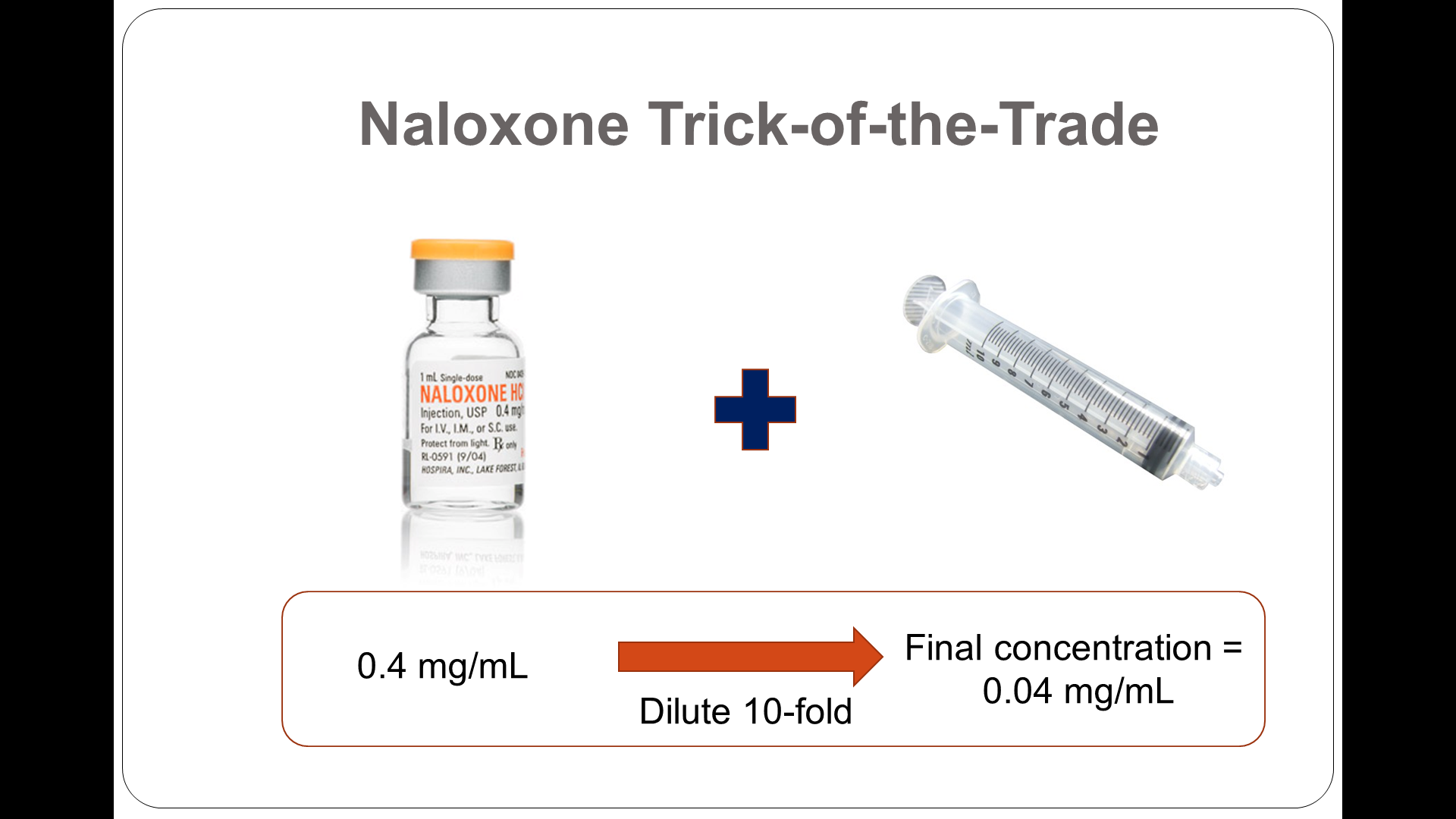
Trick of the Trade: Naloxone Dilution for Opioid Overdose
Traditional teaching recommends naloxone doses of at least 0.4 mg IV to reverse opioid toxicity. Drs. Lewis Nelson (@LNelsonMD) and Mary Ann Howland (@Howland_Ann) co-authored the opioid antagonist chapter in Goldfrank’s Toxicologic Emergencies.1 They write: “However, this dose [0.4 mg] in an opioid-dependent patient usually produces withdrawal, which should be avoided if possible. The goal is to produce a spontaneously and adequately ventilating patient without precipitating significant or abrupt opioid withdrawal. Therefore, 0.04 mg is a practical starting dose in most patients, increasing to 0.4 mg, 2 mg, and finally 10 mg.” [+]

ALiEM-Annals of EM Journal Club: Spontaneous pneumothorax, pigtail catheters, and outpatient management
We are very excited this month to bring you another installment of the ALiEM-Annals of EM Global Journal Club. The highlighted article is Voison et al. on the “Ambulatory Management of Large Spontaneous Pneumothorax With Pigtail Catheters.” We hope you will participate in an online discussion based on the clinical vignette and questions below from now until Nov 17, 2014. Respond by commenting below or tweeting using the hashtag #ALiEMJC. In a few months, a summary of this journal club will be published in Annals of EM. On Fri, Nov 14, 2014, we hosted a live Google Hangout with Dr. Stéphane Jouneau, the senior author of [+]
AIR Series: Peripheral Vascular Disease Module 2014
Welcome to the fourth ALiEM Approved Instructional Resources (AIR) Module! In an effort to reward our residents for the reading and learning they are already doing online, we have created an Individual Interactive Instruction (III) opportunity utilizing FOAM resources for U.S. Emergency Medicine residents. For each module, the AIR board curates and scores a list of blogs and podcasts. A quiz is available to complete after each module to obtain residency conference credit. Once completed, your name and institution will be logged into our private database, which participating residency program directors can access to provide proof of completion. [+]
Trick of the Trade: Mix Ceftriaxone IM with Lidocaine for Less Pain
Ceftriaxone is a broad-spectrum antibiotic that is frequently administered intramuscularly (IM) in emergency medicine. However, these injections hurt — A LOT! Can we do anything to minimize the pain? [+]

Director of Growth, Strategic Alliance Initiative, Center [+]
Mythbusting the Banana Bag
We’re all pretty familiar with the banana bag: intravenous (IV) fluids with the addition of thiamine, folic acid, multivitamins, and sometimes magnesium. Banana bags are commonly utilized in patients at risk for alcohol withdrawal symptoms or those who present to the emergency department (ED) acutely intoxicated. [+]
Director of Growth, Strategic Alliance Initiative, Center for Innovation and Digital Health
Massachusetts General Hospital;
Chief Scientific Officer, Conductscience.com
Latest posts by Shuhan He, MD (see all)
- The Discharge Severity Index: Early Research on ED Readmission Risk Assessment - August 14, 2025
- Suboxone and the Emergency Physician: Get Waivered Training - August 12, 2022
- A Tale of Two Epidemics: COVID-19 and the Opioid Crisis - April 23, 2020